
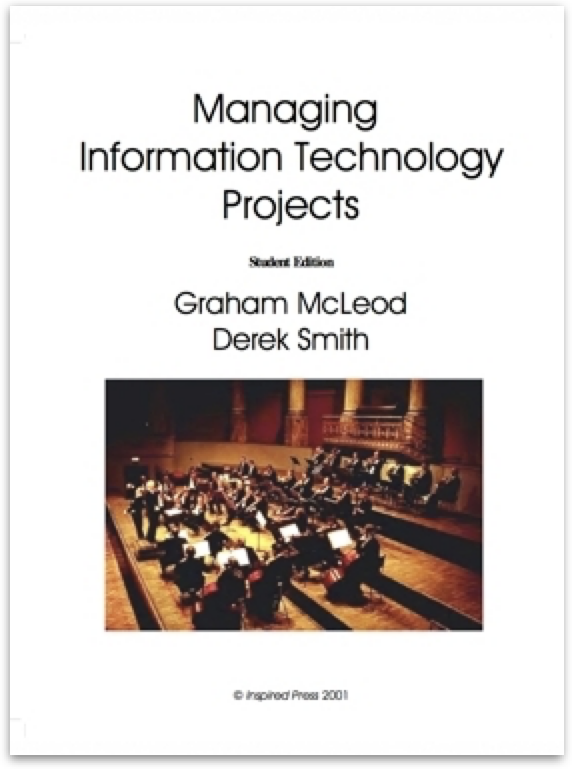
Most project management texts focus on either general methodology or system development — very few address the full range of IT project types a practising manager actually faces. Co-authored with Derek Smith and drawing on 45 years of combined industry experience, this book equips IT and information systems project managers with the knowledge to handle everything from systems development and package implementation to hardware installation and business process reengineering. It covers planning, scope and change control, risk management, quality, and the people skills that determine whether projects succeed or fail.

UML brought valuable standardisation to object-oriented analysis and design, but leaves critical gaps: no standard process, weak dynamic modelling, and little architectural guidance for building flexible, maintainable systems. This book presents the Inspired Method — developed and refined over decades of commercial practice — as a comprehensive alternative covering the full lifecycle from business analysis through design, architecture, and delivery. It is aimed at developers and analysts building multi-user, database-backed commercial applications who need a rigorous yet accessible approach that actually works in practice.
UML's Use Cases are widely used for requirements capture, but they encourage a system-centric view too early and lack the semantics to properly model complete business processes — including flow, costs, timing, organisational responsibility, and manual activities. This paper proposes a richer process modelling notation that forms a superset of Use Cases and Activity Diagrams, and transitions seamlessly from high-level stakeholder models all the way to rigorous design specifications. The approach, developed and refined through teaching and consulting, addresses a persistent gap in object-oriented analysis and enterprise engineering.
As enterprise architecture initiatives grow to span multiple teams, geographies, and time zones, the repositories and tools supporting them face real challenges: information overload, ownership conflicts, version management, and the need to present different views to different user communities. This paper formalises a set of meta model and meta-meta model extensions — including context, domains, filters, versioning, and scenarios — developed through real-world deployment of a collaborative EA modelling platform. The result is a more manageable, flexible, and scalable foundation for large-scale collaborative architecture work.
Process modelling initiatives frequently consume months of effort without producing meaningful results — often because teams dive into detailed models before anyone understands the big picture. This paper argues for a clear separation between process architecture (a rapid, high-level view of what processes exist, who they serve, and how they connect) and detailed process modelling and design, while keeping both perspectives fully integrated. Drawing on case studies from financial services organisations, it shows how this approach can cut project time dramatically and produce models that business stakeholders actually engage with.
Enterprise architecture tools struggle to interoperate, and existing exchange standards like XMI are notoriously unreliable in practice. This paper proposes MEAL — a Meta Enterprise Architecture Language — a human-readable, domain-specific language designed to define, populate, query, and analyse EA models and repositories, and to serve as a high-level API between tools. It presents the requirements, a prototype implementation in Smalltalk, and example syntax demonstrating the concept's practical promise.
Wardley Maps offer a powerful way to analyse a business's competitive landscape, value chain, and the evolution of its components — but most Enterprise Architecture frameworks have not formally incorporated them. This paper examines how Wardley Mapping complements EA methods, proposes a meta model integration using the Inspired Holistic Architecture Language (HAL), and demonstrates practical benefits including reduced effort, improved model fidelity, and richer strategic insight. A useful read for enterprise architects and business architects looking to bring greater contextual awareness into their architecture practice.