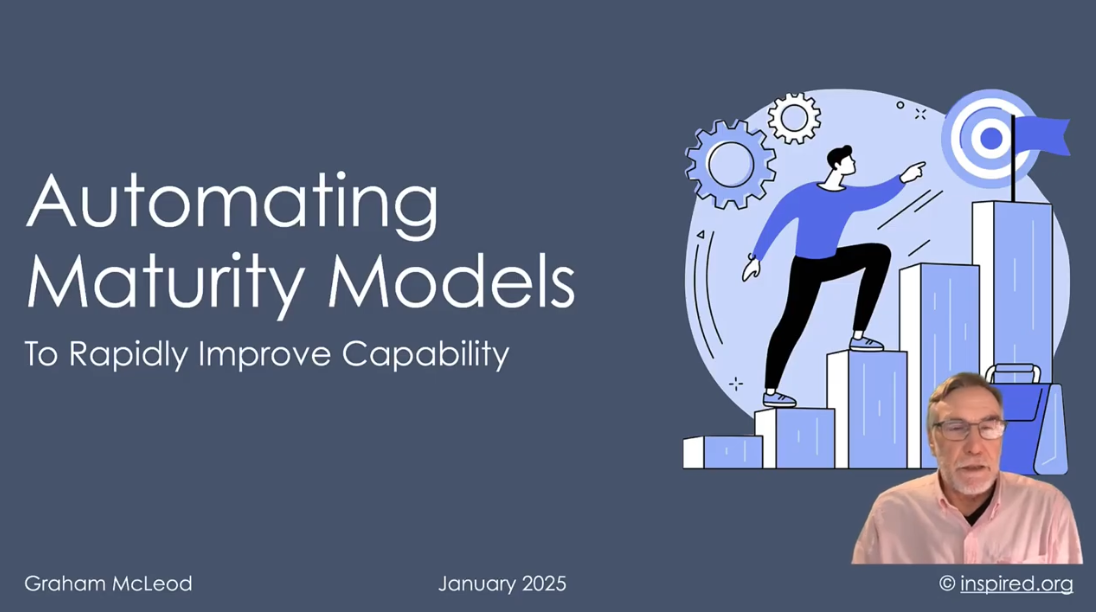

Automating Maturity Model Assessments with EVA

How can organisations automate maturity model assessments to accelerate capability improvement?

This demo shows the EVA platform in action, hosting and running maturity model assessments across disciplines including data management, digital transformation, enterprise architecture, and business architecture. The tool guides assessors through structured capability dimensions and generates scored results with improvement guidance — making the assessment process faster, more consistent, and immediately actionable.

Presented by Graham McLeod, January 2025.

Zero CRUD and Extreme Agility with UI Patterns and Meta Driven Applications

How can developers eliminate repetitive CRUD coding and build applications that adapt at runtime without redeployment?

Most business applications spend the majority of their development budget on routine Create, Read, Update, and Delete functionality — a problem that was solved decades ago. This presentation argues that by treating agility as a stable design requirement, and combining live domain meta-models with reusable UI and process patterns, developers can eliminate CRUD coding almost entirely and deliver systems that users can adapt themselves without developer intervention.

Presented by Graham McLeod at the Geekle World Software Architecture Conference, January 2021

Design and Support of Modelling Languages for Effective Graphical Representation, Analysis and Communication

How can visual modelling languages in enterprise architecture be designed to genuinely communicate meaning — rather than confusing or alienating the stakeholders they're meant to serve?

This video accompanies the paper: Designing Effective Visual Languages for Enterprise Modelling and the presentation: Designing an Effective Graphical Modelling Language

Graphical models are central to enterprise architecture and information systems work, yet they frequently fail to deliver value — not because the underlying analysis is wrong, but because the notations are poorly designed, mismatched to their audience, or unable to highlight what matters. This doctoral research paper sets out a programme of design science research aimed at improving visual language design and tooling, drawing on insights from human cognition, perception, semiotics, and graphic design. It introduces polymetric diagramming as a technique for making models more expressive and proposes a meta-meta model and tool architecture to support more effective visual language design and use.

Originally published as a doctoral consortium paper by Graham McLeod in the PoEM 2018 Doctoral Consortium Proceedings (CEUR-WS Vol. 2234), Vienna, Austria, 2018.