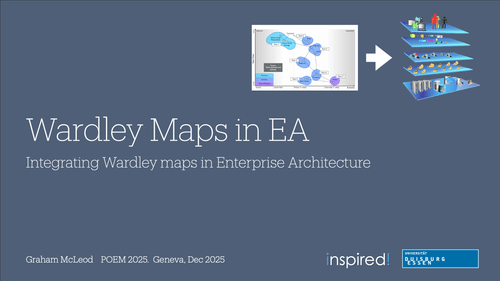

Wardley Maps in Enterprise Architecture

How can Wardley Maps be integrated with Enterprise Architecture frameworks to improve strategic planning?

These slides accompany the paper: Wardley Maps in Enterprise Architecture

Most Enterprise Architecture frameworks — including TOGAF, ArchiMate, and Zachman — address business and technology change effectively, but few formally account for the broader context in which an organisation operates: where it sits in its competitive landscape, how its components are evolving, and what strategic options that evolution creates. This paper argues that Wardley Mapping fills precisely that gap, and proposes a concrete approach for integrating it with EA practice. Drawing on the Inspired Holistic Architecture Language (HAL), Graham McLeod shows that nearly all the concepts required for Wardley Maps — stakeholders, capabilities, value chains, maturity levels — are already present in a well-constructed EA meta model, making integration more straightforward than it might appear. The paper introduces a stratified Wardley Map format that aligns visual layers with EA meta model types, and reports on early use of the integrated approach in client workshops and a Business Architecture Mastery Programme. For enterprise architects and business architects, this integration offers a practical way to add dynamic, evolution-aware thinking to existing EA models without starting from scratch.

Originally published as a conference paper in the PoEM 2025 Companion Proceedings (18th IFIP Working Conference on the Practice of Enterprise Modeling), Geneva, 2025.

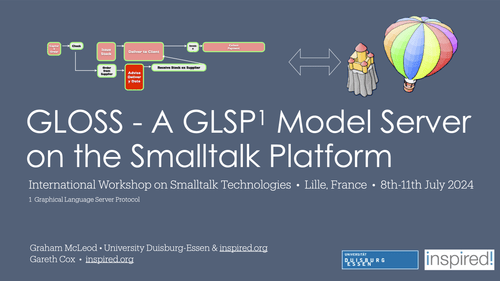
GLOSS - A GLSP Model Server on the Smalltalk Platform

Can Smalltalk serve as a modern platform for graphical modelling tools — and what does implementing the GLSP protocol reveal about its strengths and limitations?

These slides accompany the paper: GLOSS - A GLSP Model Server on the Smalltalk Platform

The Graphical Language Server Protocol (GLSP) extends the widely adopted Language Server Protocol into the graphical modelling domain, enabling web-based modelling clients to communicate with back-end model servers in a loosely coupled, standardised way. Existing reference implementations exist in Java and TypeScript, but no Smalltalk implementation existed at the outset of this project. Graham McLeod and Gareth Cox set out to build one — christened GLOSS (Graphical Language Object Server in Smalltalk) — using Pharo, and to evaluate how well GLSP maps to the architecture of the authors' existing EVA graphical modelling environment.

The paper documents the design and implementation of GLOSS, tracing the decisions made and challenges encountered, and provides a detailed architectural comparison between the GLSP approach and the EVA/GM system developed over two decades at Inspired. The comparison is striking: the Smalltalk implementation of a multi-model-type server supporting the full GLSP protocol runs to under 4,000 lines of code, compared to over 58,000 lines for the Java reference implementation of a single model type. Beyond code volume, the paper identifies nine concrete limitations in the current GLSP protocol — including the absence of model type support, server-side symbol management, and item reuse across models — and proposes specific remedies for each.

For practitioners working on modelling tools, architecture repositories, or graphical language design, this paper offers both a working proof of concept and a substantive critique of an emerging standard.

Originally published as a conference paper by Graham McLeod and Gareth Cox at the International Workshop on Smalltalk Technologies (IWST 2024), Lille, France, 2024.

Integrated Meta Model for Enterprise Modelling including Strategy, Business Architecture, Risk and Change

How can a single integrated meta model support strategy, business architecture, risk, and change across multiple EA frameworks — and why do existing approaches fall short?

These slides accompany the paper: Integrated Meta Model for Enterprise Modelling including Strategy, Business Architecture, Risk and Change

The major enterprise architecture frameworks each bring something valuable, but none are sufficient on their own. TOGAF covers IT domains reasonably well but lacks the contextual concepts — competitors, legislation, market forces, ecology — essential for genuine strategic planning. ArchiMate is more rigorous and consistent but weak on data modelling and context. BizBOK is focused but narrow. None of them, individually or together, provide a single coherent foundation for the full scope of strategy, business architecture, risk, change, and programme management that large transformation efforts demand.

This paper describes the development of HAL2023, the latest iteration of the Inspired Holistic Architecture Language — built by systematically analysing and synthesising TOGAF 10th Edition, ArchiMate 3.2, BizBOK 11, SABSA, MEMO, DODAF, and the accumulated Inspired consulting models. The result is a large but well-structured integrated meta model, expressed at three levels — rich pictures for executives, conceptual models for architects, and fully attributed models for tooling — and validated across projects in banking, telecommunications, assurance, retail, healthcare, and government. Notable enhancements in this revision include richer contextual coverage, rationalised relationship types, financial aspects, customer journeys, architecture scenarios, and improved integration with risk, governance, and initiative management.

Crucially, the paper is practical as well as theoretical: it explains how the model should be used incrementally rather than exhaustively, with teams populating only what is relevant to current goals — progressively expanding coverage as new questions arise, much like the way an ERP system delivers increasing value as more modules are adopted.

Originally published as a conference paper by Graham McLeod in the PoEM 2023 Companion Proceedings (16th IFIP Working Conference on the Practice of Enterprise Modeling), Vienna, 2023.

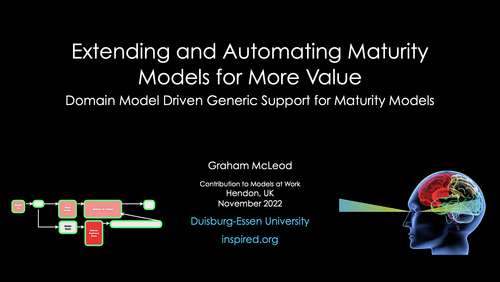
Extending and Automating Maturity Models for More Value

How can maturity models be extended beyond a simple rating to deliver recommendations, prioritised actions, and a path forward — and automated to remove the friction of doing so?

These slides accompany the paper: Extending and Automating Maturity Models for More Value

Maturity models are a staple diagnostic tool in enterprise architecture and information systems — but in practice, their value is often squandered. Organisations complete an assessment, receive a score, and are left to figure out what to do next. The friction of collecting data, calculating ratings, and managing results over time further discourages repeated use. This paper tackles both problems: how to extend the model itself to provide genuine guidance, and how to automate the process so that the effort of running an assessment becomes trivial.

The paper presents a generic domain model for maturity assessment, developed and validated at Inspired.org, which supports not just scoring across multiple dimensions but also recommendations tied to each gap between maturity levels, with relative effort ratings and dependency relationships between recommended actions. An algorithm prioritises recommendations by combining score gaps, effort, and dependency order — producing a ranked, actionable improvement plan rather than a list of observations. The domain model was implemented in the EVA platform in approximately two hours, with the full online assessment flow — including Kiviat chart scoring, recommendation presentation, action selection, and Gantt chart export — delivered in under a week. APIs were subsequently added to support integration with partner systems, adding around three days of effort.

The paper concludes with a reflection on Return on Modelling Effort (ROME): working at the domain concept level, rather than writing custom application code, enabled rapid delivery, easy adaptation, and high reuse — making this a compelling case for meta model-driven, low-code approaches to enterprise tooling.

Originally published as a journal article by Graham McLeod in the EMISA Journal (Enterprise Modelling and Information Systems Architectures), with a companion presentation at the Models at Work stream, PoEM 2022.

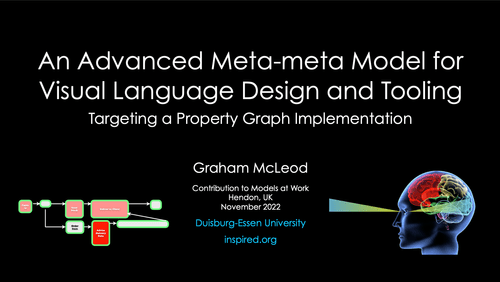
An Advanced Meta-meta Model for Visual Language Design and Tooling

How can enterprise modelling tools be designed to support rapid, flexible visual language definition without requiring programming skills or costly redevelopment cycles?

These slides accompany the paper: An Advanced Meta-meta Model for Visual Language Design and Tooling

Visual languages are central to enterprise modelling — from ArchiMate and BPMN to UML and custom domain-specific notations — but the tools that support them have a persistent problem: they are built around fixed meta models and hard-coded notations, making it difficult to adapt them for new purposes, different stakeholder groups, or evolving modelling needs. The result is a chronic mismatch between what tools offer and what practitioners actually need, compounded by the high cost and skill requirements of extending or replacing those tools.

This paper addresses the problem at its root by presenting an advanced meta-meta model — the layer that governs how concepts, relationships, properties, and visual representations are defined within a modelling environment. The model supports arbitrary meta model definition, multiple simultaneous visual languages for the same semantic model, rich property types, multi-level modelling, run-time extension without coding, and polymetric diagramming (where visual properties like size and colour reflect underlying data). It targets a property graph implementation, which offers a more natural fit for the richly interconnected structures of enterprise modelling than traditional relational or object databases. The design draws critically on two decades of experience with the EVA toolset — cataloguing what works well and what its architecture cannot support — alongside a systematic review of Eclipse EMF, MetaEdit+, XModeler, RDF/OWL, and property graph systems.

For researchers and tool builders working on the next generation of enterprise modelling environments, this paper provides both a rigorous theoretical foundation and a practically motivated design.

Originally published as a journal article by Graham McLeod in the EMISA Journal (Enterprise Modelling and Information Systems Architectures), with a companion presentation at the Models at Work stream, PoEM 2022.

AI Goes Mainstream: What Business Architects Need to Know

What is AI, how did it get here, and what does it mean for business architecture?

Artificial intelligence moved from research curiosity to mainstream business tool with remarkable speed, and this 2022 presentation — delivered at the Inspired Business Architecture Forum — captures that inflection point. Graham McLeod and Dr Jay van Zyl trace the history of AI and machine learning from the 1940s to the early 2020s, building a working vocabulary and mapping the rapidly evolving ecosystem of models, frameworks, and platforms. The presentation examines who the major players are — Google DeepMind, Microsoft/OpenAI, Meta, Apple, and Tesla — and how the market is layering from large foundation models down to end-user applications. Crucially for practitioners, it identifies the direct implications of AI for business architecture: product and service design, business intelligence, process automation, customer experience, and the ethical and governance questions that follow. The closing message is unambiguous — business architects who ignore AI do so at their peril.

Originally presented by Graham McLeod and Dr Jay van Zyl at the Inspired Business Architecture Forum, 2022.

How Business Architecture Informs Requirements

How does business architecture provide the context that makes requirements meaningful?

Requirements gathering that ignores the broader enterprise context produces solutions that solve the wrong problems. This presentation by Graham McLeod establishes why business architecture is a prerequisite for good requirements engineering, not an optional upstream activity. It walks through the key business architecture perspectives — motivation, value streams, operating models, functions, processes, services, and business capabilities — and shows how each one contributes to defining scope, surfacing gaps, and grounding solution requirements in business reality. A particularly useful section contrasts the enterprise architecture view (breadth, context, planning) with the solution architecture view (depth, design, delivery), using the analogy of city planning versus building design. The presentation also covers gap analysis and the role of reference models in assessing solution options against current capability.

Originally presented by Graham McLeod at Inspired events, 2018–2023.

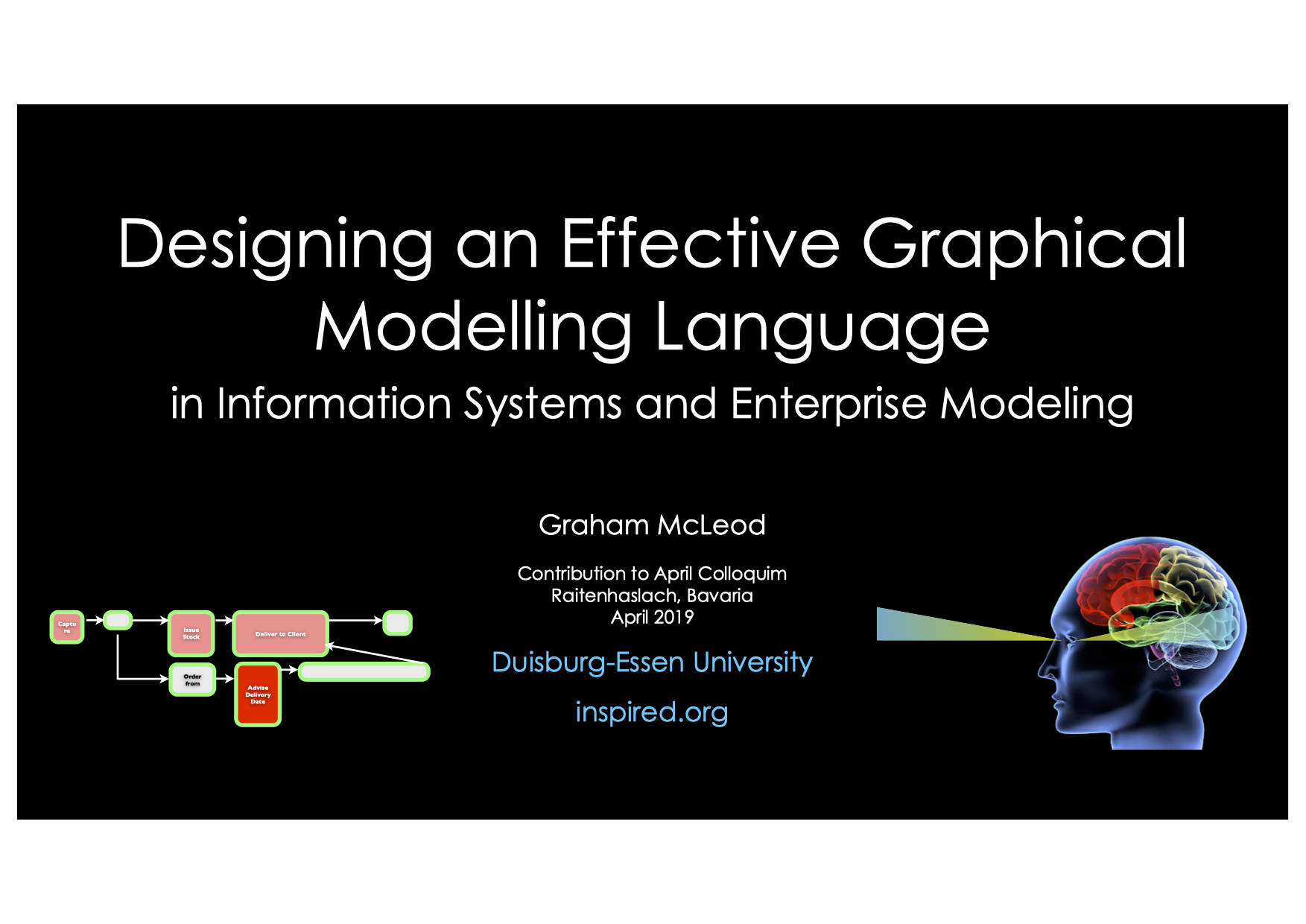
Designing an Effective Graphical Modelling Language

How can visual modelling languages in enterprise architecture be designed to genuinely communicate meaning — rather than confusing or alienating the stakeholders they're meant to serve?

These slides accompany the paper: Designing Effective Visual Languages for Enterprise Modelling and a video of the presentation is available here: Design and Support of Modelling Languages for Effective Graphical Representation, Analysis and Communication

Graphical models are everywhere in enterprise architecture — yet a persistent gap exists between the effort invested in building them and the value they deliver. Models are too technical for business audiences, too homogenous to highlight what matters, or presented in formats that stakeholders simply cannot parse. When practitioners try to bridge this gap by converting rigorous models into PowerPoint slides or Word documents, they sever the connection to the underlying repository — destroying integrity, reusability, and currency in the process.

This paper presents the research programme Graham McLeod is pursuing at the University of Duisburg-Essen, supervised by Prof. Ulrich Frank, to address these problems at a foundational level. The research draws on human visual cognition, semiotics, information encoding theory, the Physics of Notations, and the emerging field of polymetric diagramming — a technique that modifies visual symbol properties such as size, colour, and shape to reflect underlying data, enabling pre-attentive processing and rapid identification of important patterns in large, complex models. The proposed contributions include extended theory for visual notation design, a meta-meta model supporting multiple visual languages over the same semantic model, and a layered tool architecture enabling runtime adaptation of models to purpose, audience, and medium.

For enterprise architects, this research points toward a future where modelling tools can produce representations genuinely suited to a CFO, a process owner, or a technical architect — from the same underlying repository, without manual translation.

Originally published as a doctoral consortium paper by Graham McLeod in the PoEM 2018 Doctoral Consortium Proceedings (CEUR-WS Vol. 2234), Vienna, Austria, 2018.

The Power of Principles

Why are architecture principles the highest-return activity in enterprise architecture — and how do you define good ones?

Architecture principles are among the most powerful tools available to enterprise architects — yet they are frequently underdefined, poorly worded, or neglected altogether. This 2014 presentation by Graham McLeod makes the case that well-crafted principles, spanning business, application, information, and technology domains, represent the highest return on effort of almost any EA activity: a relatively small investment that shapes decisions across the entire organisation for years. Drawing on experience across banking, assurance, and telecommunications, the presentation covers what distinguishes a principle from a rule, how to structure principles effectively using the short name, statement, rationale, and implications format, and how to engage stakeholders in the definition process. A particularly useful concept is the "stealth payload" — the idea that while principle statements tend to be irrefutable, the implications are where the real architectural direction is embedded. The presentation also addresses compliance monitoring, showing how architecture assets can be mapped against principles and tracked over time to drive meaningful governance.

Originally presented by Graham McLeod at the Enterprise Architecture Conference Europe 2014 & Business Process Management Conference Europe 2014, June 2014.

Should Banks Outsource Operations Processing? Drivers, Constraints, and the EA Angle

What drives and constrains outsourcing decisions in corporate and investment banking — and what role should enterprise architects play?

Outsourcing operations processing is a live and recurring challenge for executive leaders in corporate and investment banking — and the decision is rarely as simple as comparing internal and external costs. This 2013 presentation by SJ van der Westhuizen, delivered at the Inspired TOGAF/EA Forum in Johannesburg, draws on research across thirteen banking organisations to map the full set of forces at play, distinguishing clearly between what drives outsourcing and what constrains it.

On the driving side, the research identifies capability maturity, capital preservation, management focus, and the formalising effect of contracts as significant positive forces. On the constraining side, organisational form complexity, responsiveness to change, reputational risk, management culture fit, and capability maturity concerns about prospective vendors all emerge as meaningful brakes. Cost and revenue, often assumed to be the dominant drivers, are shown to be more nuanced than executives typically expect.

A particularly valuable thread running through the presentation is the specific contribution enterprise architecture can make at each decision point — from capability-based planning and CMMI assessment, to operating model design, TOGAF governance frameworks, and the business model canvas. The central conclusion is direct: the greater the level of EA maturity in an organisation, the greater the number of business objectives achievable through outsourcing.

Originally presented by SJ van der Westhuizen at the Inspired TOGAF/EA Forum, Johannesburg, July 2013.

New Technology Creates Architecture Opportunity

How should enterprise architects respond when exponential technology change reshapes what's possible?

Technology does not advance linearly — and enterprise architects who plan as if it does will consistently underestimate what is both possible and necessary. This 2013 presentation by Graham McLeod surveys the wave of exponential technologies then reshaping the landscape: mobile and internet connectivity, big data and analytics, semantic technology and linked data, social networks, nanotechnology, robotics, and 3D printing. For each, the presentation draws out not just what the technology does, but what it makes architecturally possible — from radically compressed value chains enabled by 3D printing, to "world processing" application architectures that collect, merge, analyse, and visualise data at scale. A particularly striking section examines network effects and the speed at which new platforms achieve mass adoption, underscoring the pace at which architectural assumptions can be overtaken. The closing message is clear: technology advances are not background noise for enterprise architects — they are the signal.

Originally presented by Graham McLeod at an Inspired event, October 2013.

More Insights Without More Effort: Polymetric Modelling and Visual Intelligence in Enterprise Architecture

How can enterprise architects extract far more insight from their models without significantly increasing the effort required?

The effort required to collect, validate, analyse, and report on enterprise architecture information is itself one of the biggest obstacles to EA delivering value — and yet most approaches simply accept that effort as a given. This 2013 presentation by Graham McLeod challenges that assumption directly, arguing that the right combination of integrated meta models, inferencing, derived values, and visual techniques can dramatically increase the insight produced by an EA repository without requiring proportionally more effort to maintain it. A particularly compelling section introduces polymetric diagramming — a technique that modifies the visual properties of model symbols (size, colour, shape, border width, position) based on the actual data values of the objects they represent, turning what would otherwise be static structural diagrams into rich, information-dense pictures that exploit the human visual system's innate ability to detect patterns, movement, and anomalies. Worked examples show function models where symbol width reflects delay time, process models where width maps to duration, height to cost, and colour intensity to resource consumption, and application maps clustered and sized by investment or number of non-standard interfaces. The underlying architecture — a separation of logical model types from their visual representations, with polymetric specifications scripted in a flexible DSL — is implemented in Pharo Smalltalk using the Mondrian and Roassal graphics libraries and the EVA Graphical Modeler. For practitioners wrestling with the gap between the volume of data in their EA repositories and the quality of insight they can extract from it, this presentation offers both a compelling vision and a concrete technical path.

Originally presented by Graham McLeod at an Inspired event, September 2013.

A Business and Solution Building Block Approach to EA Project Planning

How can enterprise architects bring clarity to project scope, release planning, and stakeholder communication across complex, interdependent programmes?

These slides accompany the paper: A Business and Solution Building Block Approach to EA Project Planning

When multiple projects are running in parallel — each with its own business analyst, development team, and agile backlog — it becomes surprisingly easy for scope, dependencies, and release content to become invisible to the people who most need to understand them: sponsors, stakeholders, and programme managers. This paper documents exactly that problem at a rapidly expanding South African telecoms company, where two major projects (Quoting and Billing) were underway with little consensus on scope, no agreed release breakdown, and a growing disconnect between business expectations and development plans.

The solution was a structured building block approach, distinguishing Business Building Blocks (BBBs) — capability-level components independent of technology choices — from Solution Building Blocks (SBBs), representing the actual systems, data sources, and infrastructure chosen to implement them. A facilitated workshop produced a BBB diagram showing capabilities, dependencies, and release groupings at a glance; a release matrix then mapped capability and content coverage to delivery timelines. Both were formalised in a meta model and implemented in the EVA Netmodeler repository, enabling traceability from business requirements through to agile backlogs and programme milestones.

The approach was well received across all stakeholder groups — sponsors, strategists, and programme managers reported that they finally had a clear, shared picture of what each project would deliver and when. The paper includes the full meta model, visual examples, and an honest reflection on adoption challenges, making it a practical reference for any EA function working to improve programme visibility and stakeholder alignment.

Originally published as a conference paper by Graham McLeod, Inspired.org / University of Cape Town, circa 2013–2014.

Real Business Architecture: Strategy, Design Thinking, and the Bigger Picture

How does business architecture go beyond conventional scope to become a genuine driver of business transformation?

Most treatments of business architecture focus on functions, processes, and capabilities — important, but incomplete. This 2012 presentation by Graham McLeod, delivered at The Open Group Enterprise Transformation Conference in Cannes, makes the case that the true scope of business architecture is much broader: encompassing innovation and design thinking, customer value and emotion, external context, emerging technology, and the full range of strategic concerns that drive organisational change. Drawing on TOGAF 9, Archimate 2, and the Inspired framework, the presentation maps out an expanded meta model that integrates motivation, functional, process, service, and capability perspectives — and shows how these are not competing views but complementary lenses that can be reconciled. A compelling section examines the transformative forces reshaping business in 2012 — cloud, big data, social media, additive manufacturing, and the rise of design-driven companies — and asks what business architects must do to stay relevant. Case examples from Apple, Volkswagen, and others illustrate how architectural thinking at the right level of abstraction enables the kind of strategic clarity that transforms organisations. The closing argument is unambiguous: business architecture practised at its full scope is a board-level strategic capability, not a documentation exercise.

Originally presented by Graham McLeod at The Open Group Enterprise Transformation Conference, Cannes, France, April 2012.

Semantic Technologies and the Web of Meaning: An Introduction for Enterprise Practitioners

What are semantic technologies, how do they work, and why do they matter for enterprise architecture and information management?

The World Wide Web was built to share documents between humans — but semantic technologies, as Tim Berners-Lee foresaw from the outset, make it possible to share and query meaning between machines at web scale. This 2011 lecture by Graham McLeod, delivered at the University of Cape Town, provides a thorough and accessible introduction to the semantic web stack for enterprise practitioners.

Starting from first principles — what semantics means, and why the distinction between syntax and meaning matters — the lecture works through the core W3C standards: RDF as a graph-based data model where every fact is uniquely addressable via a URI, SPARQL as the query language that can span multiple distributed datasets as a single conceptual database, OWL as the web ontology language that enables classification, inferencing, and richer knowledge organisation, and linked open data as the practical realisation of these ideas at internet scale.

A particularly illuminating section demonstrates how two independently published datasets about the same book — one in English, one in French — can be automatically merged and queried together simply by sharing a common URI and a few bridging statements, illustrating the power of the approach for enterprise data integration. Real-world applications covered include Siri, DBPedia, semantic video indexing, and geo-spatial data integration.

For enterprise architects and information architects grappling with data integration, knowledge management, or the foundations of AI-driven systems, this lecture provides both the conceptual grounding and the practical vocabulary needed to engage seriously with semantic technologies.

Originally presented by Graham McLeod as a guest lecture at the University of Cape Town, June 2011.

From Chief Information Officer to Chief Innovation Officer

How should enterprise architects and CIOs reframe their role in a world where innovation has become a survival issue?

Business models that were sound five years ago are already obsolete, and the pace of change is only accelerating. This 2011 presentation by Graham McLeod — delivered under the provocative subtitle "Get out of your cubicle and into the future!" — challenges CIOs and enterprise architects to fundamentally reframe their role in response to a world being reshaped by exponential forces. Drawing on Ray Kurzweil's computing power curves, the explosive growth of social media, the collapse of traditional value chains through 3D printing and digital distribution, and the rise of semantic and AI-driven applications, the presentation paints a vivid picture of the environment in which organisations must now compete. The central argument is that staying where you are is itself a risk — and that the architects and technology leaders best placed to lead are those who can connect these broad external change themes to the structure of the enterprise: its business architecture, processes, applications, information, and technology. A particularly compelling section examines innovation as a managed capability, drawing on examples from Procter & Gamble and Cisco to show how structured innovation processes, social tools, and external networks can be embedded in the operating model. The closing message is direct: design thinking, innovation models, and an outward-facing perspective are no longer optional extras for enterprise architects — they are core competencies.

Originally presented by Graham McLeod at an Inspired event, March 2011.

Engaging Real Business People in Real Business Architecture

Why do business executives avoid enterprise architecture — and how do you get them genuinely engaged?

The complaint is common among IT architects: business executives won't engage with enterprise architecture, leaving the whole effort directionless. But as this 2009 presentation by Graham McLeod argues, the real problem lies with what is typically presented to business people as "business architecture" — a technically framed, detail-heavy, IT-grown discipline that offers little of immediate relevance to the executives who actually own the business. Delivered at The Open Group EA Practitioners Conference in London, the presentation sets out both a diagnosis and a remedy. The diagnosis: most EA has grown upward from IT rather than downward from business strategy, and neither TOGAF nor most frameworks at the time adequately captured the full scope of genuine business architecture — context, markets, products, channels, customers, scenarios, and cross-cutting concerns like cost, risk, quality, and governance. The remedy: a comprehensive business architecture meta model, drawn from Inspired and PROMIS experience across banking, healthcare, assurance, telecommunications, and government, that gives executives models they recognise as their own. A particularly practical section addresses how architects must shift their role — from technical experts presenting conclusions to skilled facilitators asking good questions, holding up a mirror, and ensuring that models and content belong to the business rather than the architecture team. The presentation closes with specific suggestions for how TOGAF should expand its treatment of business architecture.

Originally presented by Graham McLeod at The Open Group EA Practitioners Conference (EAPC), London, UK, April 2009.

Meta Meta Model Extensions for Managing Large-Scale Collaborative EA Modelling

How do you extend enterprise architecture meta models to keep large-scale collaborative modelling manageable?

When enterprise architecture modelling moves beyond a single expert working alone — across teams, organisations, time zones, and languages — the meta model that was perfectly adequate for small-scale work begins to break down. Ownership conflicts, information overload, incompatible versions, and variable data quality all emerge as serious practical obstacles. This 2008 presentation by Graham McLeod, delivered at EMMSAD 2008 (Exploring Modelling Methods for Systems Analysis and Design), addresses these challenges head-on with a set of formal but pragmatic extensions to EA meta models and meta meta models, developed through real-world experience building and operating the EVA collaborative repository. The core constructs introduced include context — a powerful, reusable mechanism that operates at the meta meta level and addresses domain, ownership, authority, timeframe, status, and language in a unified way; relationship typing, which brings precision to how model elements connect; and a model type abstraction that subsumes graphical models, documents, reports, and user interfaces under a single coherent concept. A three-layer object architecture — implemented in Smalltalk — is shown to be essential for the flexibility required, with filters implemented as a specialisation of model type and time, version, and baseline tracking unified through relationships. The resulting conceptual model is notably compact given the range of challenges it addresses, and the presentation is candid about both the expressiveness achieved and the performance challenges encountered in implementation. For practitioners building or evaluating EA repository tooling, this is a rare account of what the meta model level actually needs to look like in production.

Originally presented by Graham McLeod at EMMSAD 2008 (Exploring Modelling Methods for Systems Analysis and Design), Montpellier, France, June 2008.

Service Orientation in Enterprise Architecture: Beyond Surface-Level Support

How should enterprise architecture frameworks and meta models be extended to provide genuine, deep support for service orientation?

Service orientation reshapes how applications are conceived, how systems are integrated, and ultimately how value is delivered to customers — yet most enterprise architecture frameworks treat it as a technical implementation detail rather than an architectural concern that spans the full enterprise stack. This 2008 presentation by Graham McLeod, delivered in his role as CTO of PROMIS Solutions AG, argues that achieving deep support for service orientation in EA requires rethinking frameworks and meta models from the ground up. The presentation distinguishes carefully between technical, application, information, and business services, and between logical service definitions — independent of technology and implementation — and their physical realisation, insisting that the mapping between these two levels is essential for meaningful planning and governance. A key architectural insight is the treatment of modern applications not as monolithic systems but as malleable bundles of functions exposed as services, where components can be replaced without impacting overall service delivery — a view that has significant implications for how application architecture is modelled. The presentation also addresses what it calls "enrichment": the additional concepts needed to govern services effectively, including intent (benchmarks, goals, objectives), responsibility and ownership, cross-cutting concerns (risk, cost, quality), and built-in computation and analysis. Archimate is proposed as a candidate notation for distinguishing domains and logical versus physical layers, with worked examples showing how service cross-referencing and traceability can be achieved in practice.

Originally presented by Graham McLeod at an Inspired/PROMIS event, December 2008.

The Central Role of Business Analysis in Enterprise Architecture

What role does business analysis play in enterprise architecture — and why is it central rather than peripheral?

Business analysis is frequently treated as a project-level discipline — something that happens within initiatives, not above them. This 2007 presentation by Graham McLeod challenges that view, arguing that business analysts have a central and irreplaceable role in enterprise architecture, particularly across the business and process architecture dimensions. Delivered to the IIBA Western Cape Chapter, the presentation walks through the components of EA using the Inspired frameworks, with detailed coverage of business architecture, business process architecture, and the relationship between strategy, architecture, and programme management. A key theme is requirements traceability — the clear linkage from business goals and events through to system and technology services — which demands the kind of domain knowledge and analytical rigour that experienced business analysts bring. The presentation concludes that EA represents a natural career growth path for analysts, and that organisations which keep the two disciplines separate are missing a significant opportunity.

Originally presented by Graham McLeod to the IIBA Western Cape Chapter, November 2007.