
Enterprise Modelling

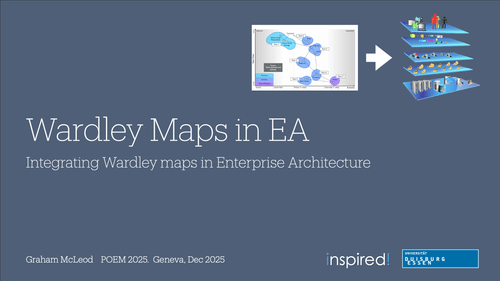
Wardley Maps in Enterprise Architecture

How can Wardley Maps be integrated with Enterprise Architecture frameworks to improve strategic planning?

These slides accompany the paper: Wardley Maps in Enterprise Architecture

Most Enterprise Architecture frameworks — including TOGAF, ArchiMate, and Zachman — address business and technology change effectively, but few formally account for the broader context in which an organisation operates: where it sits in its competitive landscape, how its components are evolving, and what strategic options that evolution creates. This paper argues that Wardley Mapping fills precisely that gap, and proposes a concrete approach for integrating it with EA practice. Drawing on the Inspired Holistic Architecture Language (HAL), Graham McLeod shows that nearly all the concepts required for Wardley Maps — stakeholders, capabilities, value chains, maturity levels — are already present in a well-constructed EA meta model, making integration more straightforward than it might appear. The paper introduces a stratified Wardley Map format that aligns visual layers with EA meta model types, and reports on early use of the integrated approach in client workshops and a Business Architecture Mastery Programme. For enterprise architects and business architects, this integration offers a practical way to add dynamic, evolution-aware thinking to existing EA models without starting from scratch.

Originally published as a conference paper in the PoEM 2025 Companion Proceedings (18th IFIP Working Conference on the Practice of Enterprise Modeling), Geneva, 2025.

Integrated Meta Model for Enterprise Modelling including Strategy, Business Architecture, Risk and Change

How can a single integrated meta model support strategy, business architecture, risk, and change across multiple EA frameworks — and why do existing approaches fall short?

These slides accompany the paper: Integrated Meta Model for Enterprise Modelling including Strategy, Business Architecture, Risk and Change

The major enterprise architecture frameworks each bring something valuable, but none are sufficient on their own. TOGAF covers IT domains reasonably well but lacks the contextual concepts — competitors, legislation, market forces, ecology — essential for genuine strategic planning. ArchiMate is more rigorous and consistent but weak on data modelling and context. BizBOK is focused but narrow. None of them, individually or together, provide a single coherent foundation for the full scope of strategy, business architecture, risk, change, and programme management that large transformation efforts demand.

This paper describes the development of HAL2023, the latest iteration of the Inspired Holistic Architecture Language — built by systematically analysing and synthesising TOGAF 10th Edition, ArchiMate 3.2, BizBOK 11, SABSA, MEMO, DODAF, and the accumulated Inspired consulting models. The result is a large but well-structured integrated meta model, expressed at three levels — rich pictures for executives, conceptual models for architects, and fully attributed models for tooling — and validated across projects in banking, telecommunications, assurance, retail, healthcare, and government. Notable enhancements in this revision include richer contextual coverage, rationalised relationship types, financial aspects, customer journeys, architecture scenarios, and improved integration with risk, governance, and initiative management.

Crucially, the paper is practical as well as theoretical: it explains how the model should be used incrementally rather than exhaustively, with teams populating only what is relevant to current goals — progressively expanding coverage as new questions arise, much like the way an ERP system delivers increasing value as more modules are adopted.

Originally published as a conference paper by Graham McLeod in the PoEM 2023 Companion Proceedings (16th IFIP Working Conference on the Practice of Enterprise Modeling), Vienna, 2023.

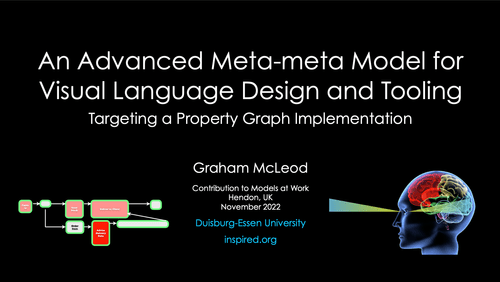
An Advanced Meta-meta Model for Visual Language Design and Tooling

How can enterprise modelling tools be designed to support rapid, flexible visual language definition without requiring programming skills or costly redevelopment cycles?

These slides accompany the paper: An Advanced Meta-meta Model for Visual Language Design and Tooling

Visual languages are central to enterprise modelling — from ArchiMate and BPMN to UML and custom domain-specific notations — but the tools that support them have a persistent problem: they are built around fixed meta models and hard-coded notations, making it difficult to adapt them for new purposes, different stakeholder groups, or evolving modelling needs. The result is a chronic mismatch between what tools offer and what practitioners actually need, compounded by the high cost and skill requirements of extending or replacing those tools.

This paper addresses the problem at its root by presenting an advanced meta-meta model — the layer that governs how concepts, relationships, properties, and visual representations are defined within a modelling environment. The model supports arbitrary meta model definition, multiple simultaneous visual languages for the same semantic model, rich property types, multi-level modelling, run-time extension without coding, and polymetric diagramming (where visual properties like size and colour reflect underlying data). It targets a property graph implementation, which offers a more natural fit for the richly interconnected structures of enterprise modelling than traditional relational or object databases. The design draws critically on two decades of experience with the EVA toolset — cataloguing what works well and what its architecture cannot support — alongside a systematic review of Eclipse EMF, MetaEdit+, XModeler, RDF/OWL, and property graph systems.

For researchers and tool builders working on the next generation of enterprise modelling environments, this paper provides both a rigorous theoretical foundation and a practically motivated design.

Originally published as a journal article by Graham McLeod in the EMISA Journal (Enterprise Modelling and Information Systems Architectures), with a companion presentation at the Models at Work stream, PoEM 2022.

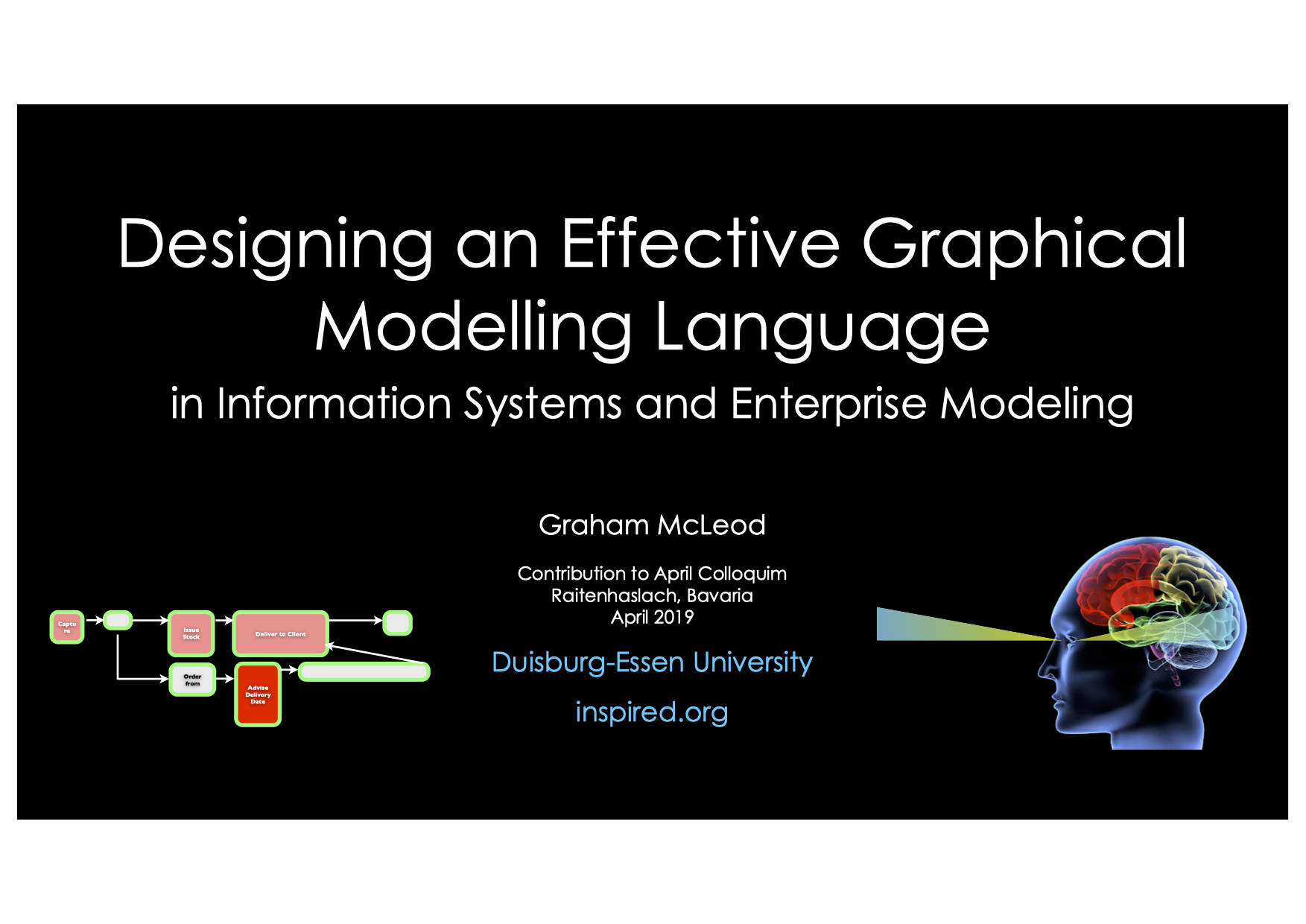
Designing an Effective Graphical Modelling Language

How can visual modelling languages in enterprise architecture be designed to genuinely communicate meaning — rather than confusing or alienating the stakeholders they're meant to serve?

These slides accompany the paper: Designing Effective Visual Languages for Enterprise Modelling and a video of the presentation is available here: Design and Support of Modelling Languages for Effective Graphical Representation, Analysis and Communication

Graphical models are everywhere in enterprise architecture — yet a persistent gap exists between the effort invested in building them and the value they deliver. Models are too technical for business audiences, too homogenous to highlight what matters, or presented in formats that stakeholders simply cannot parse. When practitioners try to bridge this gap by converting rigorous models into PowerPoint slides or Word documents, they sever the connection to the underlying repository — destroying integrity, reusability, and currency in the process.

This paper presents the research programme Graham McLeod is pursuing at the University of Duisburg-Essen, supervised by Prof. Ulrich Frank, to address these problems at a foundational level. The research draws on human visual cognition, semiotics, information encoding theory, the Physics of Notations, and the emerging field of polymetric diagramming — a technique that modifies visual symbol properties such as size, colour, and shape to reflect underlying data, enabling pre-attentive processing and rapid identification of important patterns in large, complex models. The proposed contributions include extended theory for visual notation design, a meta-meta model supporting multiple visual languages over the same semantic model, and a layered tool architecture enabling runtime adaptation of models to purpose, audience, and medium.

For enterprise architects, this research points toward a future where modelling tools can produce representations genuinely suited to a CFO, a process owner, or a technical architect — from the same underlying repository, without manual translation.

Originally published as a doctoral consortium paper by Graham McLeod in the PoEM 2018 Doctoral Consortium Proceedings (CEUR-WS Vol. 2234), Vienna, Austria, 2018.