
Wardley Maps offer a powerful way to analyse a business's competitive landscape, value chain, and the evolution of its components — but most Enterprise Architecture frameworks have not formally incorporated them. This paper examines how Wardley Mapping complements EA methods, proposes a meta model integration using the Inspired Holistic Architecture Language (HAL), and demonstrates practical benefits including reduced effort, improved model fidelity, and richer strategic insight. A useful read for enterprise architects and business architects looking to bring greater contextual awareness into their architecture practice.
Integrated Meta Model for Enterprise Modelling including Strategy, Business Architecture, Risk and Change
Popular enterprise architecture frameworks like TOGAF and ArchiMate each provide meta models, but none are broad enough to fully support strategic planning, contextual analysis, and business architecture alongside risk, change, and programme management in an integrated way. This paper describes the development of HAL2023 — an updated version of the Inspired Holistic Architecture Language — synthesising concepts from TOGAF 10, ArchiMate 3.2, BizBOK 11, SABSA, MEMO, and the Inspired consulting practice into a single, coherent meta model validated across multiple industries. It addresses not only what the model contains, but how it can be practically applied without overwhelming practitioners.
Extending and Automating Maturity Models for More Value
Maturity models are widely used for organisational self-assessment, but their value is often limited to producing a score. This paper argues that far greater value is achievable by extending models to include prioritised recommendations and action planning — and by automating the whole process to remove the friction that discourages use. Drawing on the development of a generic domain model implemented in the EVA platform, it demonstrates how a range of maturity models can be rapidly deployed, assessed, scored, and translated into actionable improvement plans with minimal custom code.
An Advanced Meta-meta Model for Visual Language Design and Tooling
Most enterprise modelling tools hard-code their notations and meta models, making adaptation slow, expensive, and technically demanding. This paper presents an advanced meta-meta model — the foundational layer that governs how modelling languages and tools are defined — designed to support arbitrary meta models, multiple visual representations, multi-level modelling, and runtime adaptation without specialist programming skills. Targeting a property graph implementation, it draws on two decades of experience with the EVA toolset and a systematic review of leading platforms including Eclipse, MetaEdit+, and XModeler.
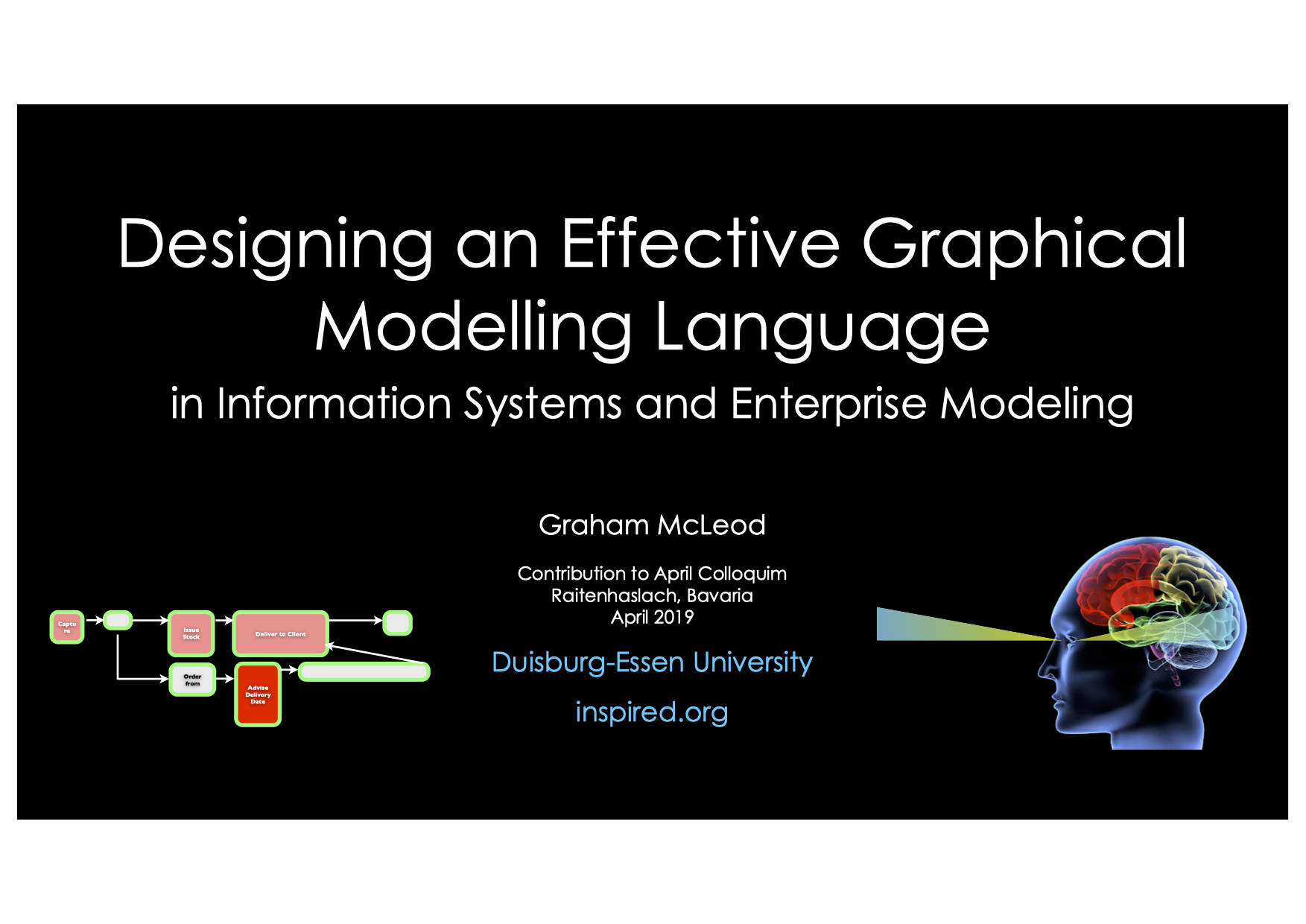
Designing an Effective Graphical Modelling Language
Graphical models are central to enterprise architecture and information systems work, yet they frequently fail to deliver value — not because the underlying analysis is wrong, but because the notations are poorly designed, mismatched to their audience, or unable to highlight what matters. This doctoral research paper sets out a programme of design science research aimed at improving visual language design and tooling, drawing on insights from human cognition, perception, semiotics, and graphic design. It introduces polymetric diagramming as a technique for making models more expressive and proposes a meta-meta model and tool architecture to support more effective visual language design and use.
AI Goes Mainstream: What Business Architects Need to Know
A 2022 overview of artificial intelligence and machine learning for business architects — covering the history of AI, the emerging ecosystem of tools and platforms, and the practical implications for business strategy, process design, and customer engagement. Presented at the Inspired Business Architecture Forum, this talk maps the landscape at a pivotal moment when AI shifted from niche technology to mainstream business reality.
How Business Architecture Informs Requirements
Requirements defined without architectural context are rarely the right requirements. This presentation explores how business architecture — spanning motivation, value streams, functions, processes, services, and capabilities — provides the essential foundation for solution delivery. Presented by Graham McLeod at Inspired events between 2018 and 2023, it bridges the gap between enterprise architecture and practical requirements engineering.
New Technology Creates Architecture Opportunity
Exponential advances in computing, communications, big data, semantic technology, robotics, and 3D printing are not just technical curiosities — they fundamentally alter what business architectures can and should do. This 2013 presentation by Graham McLeod surveys the landscape of emerging technologies and draws out the architectural implications for enterprise and application design. A timely reminder that architects who ignore technology trends risk designing for a world that no longer exists.
A Business and Solution Building Block Approach to EA Project Planning
Enterprise architecture programmes frequently struggle with scope confusion, misaligned stakeholder expectations, and poor traceability between business requirements and delivery plans. This paper presents a building block approach — distinguishing Business Building Blocks (capabilities) from Solution Building Blocks (systems and technologies) — developed and validated on a multi-project transformation programme at a rapidly expanding South African telecoms company. The result was dramatically improved communication between sponsors, stakeholders, programme managers, and development teams, and a shared, navigable picture of what would be delivered, when, and in what sequence.
The Power of Principles
Well-crafted architecture principles guide thousands of decisions across an enterprise for years — yet typically cost less than 1% of total change effort to define. This presentation by Graham McLeod explores what makes a good EA principle, how to engage stakeholders in defining them, and how principles bridge the gap between strategic intent and concrete design. Drawn from real implementations in banking, assurance, and telecommunications, it includes worked examples and a compliance monitoring approach.
The Central Role of Business Analysis in Enterprise Architecture
Business analysis and enterprise architecture overlap far more than most organisations recognise — in scope, in skills, and in the work itself. This 2007 presentation by Graham McLeod, delivered to the IIBA Western Cape Chapter, makes the case that business analysts are not just contributors to EA but play a central role in shaping business architecture, defining requirements, and bridging strategy with delivery. It covers business and process architecture, requirements traceability, and the career growth path from business analysis into enterprise architecture.
What Should an EA Management Tool Actually Do?
Most organisations attempting enterprise architecture have reached for ad-hoc tools — Word, Excel, Visio — or CASE-derived modelling tools never designed for the job. This 2005 presentation by Graham McLeod sets out a comprehensive framework of requirements for a purpose-built EA management tool, drawing on Zachman, TOGAF, Spewak, and Schekkerman, before presenting the design and architecture of Archi/WebModeler, Inspired's own web-based EA repository solution. It covers everything from meta-modelling and collaboration to inferencing, scenario management, and governance support.
Enhancing Enterprise Architecture Models with Cost, Quality and Risk Dimensions
Enterprise architecture models are typically rich in structural detail but silent on cost, quality, and risk — the very dimensions that drive executive decision-making. This 2003 presentation by Graham McLeod, delivered at the University of Cape Town, explores how EA models can be extended with these critical dimensions using a knowledge repository approach, enabling architects and business managers to assess current and future scenarios with a fuller picture of the implications of their decisions.