

Value Chain

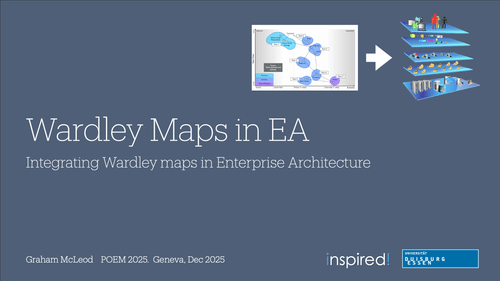
Wardley Maps in Enterprise Architecture

How can Wardley Maps be integrated with Enterprise Architecture frameworks to improve strategic planning?

These slides accompany the paper: Wardley Maps in Enterprise Architecture

Most Enterprise Architecture frameworks — including TOGAF, ArchiMate, and Zachman — address business and technology change effectively, but few formally account for the broader context in which an organisation operates: where it sits in its competitive landscape, how its components are evolving, and what strategic options that evolution creates. This paper argues that Wardley Mapping fills precisely that gap, and proposes a concrete approach for integrating it with EA practice. Drawing on the Inspired Holistic Architecture Language (HAL), Graham McLeod shows that nearly all the concepts required for Wardley Maps — stakeholders, capabilities, value chains, maturity levels — are already present in a well-constructed EA meta model, making integration more straightforward than it might appear. The paper introduces a stratified Wardley Map format that aligns visual layers with EA meta model types, and reports on early use of the integrated approach in client workshops and a Business Architecture Mastery Programme. For enterprise architects and business architects, this integration offers a practical way to add dynamic, evolution-aware thinking to existing EA models without starting from scratch.

Originally published as a conference paper in the PoEM 2025 Companion Proceedings (18th IFIP Working Conference on the Practice of Enterprise Modeling), Geneva, 2025.


New Technology Creates Architecture Opportunity

How should enterprise architects respond when exponential technology change reshapes what's possible?

Technology does not advance linearly — and enterprise architects who plan as if it does will consistently underestimate what is both possible and necessary. This 2013 presentation by Graham McLeod surveys the wave of exponential technologies then reshaping the landscape: mobile and internet connectivity, big data and analytics, semantic technology and linked data, social networks, nanotechnology, robotics, and 3D printing. For each, the presentation draws out not just what the technology does, but what it makes architecturally possible — from radically compressed value chains enabled by 3D printing, to "world processing" application architectures that collect, merge, analyse, and visualise data at scale. A particularly striking section examines network effects and the speed at which new platforms achieve mass adoption, underscoring the pace at which architectural assumptions can be overtaken. The closing message is clear: technology advances are not background noise for enterprise architects — they are the signal.

Originally presented by Graham McLeod at an Inspired event, October 2013.

A Business and Solution Building Block Approach to EA Project Planning

How can enterprise architects bring clarity to project scope, release planning, and stakeholder communication across complex, interdependent programmes?

These slides accompany the paper: A Business and Solution Building Block Approach to EA Project Planning

When multiple projects are running in parallel — each with its own business analyst, development team, and agile backlog — it becomes surprisingly easy for scope, dependencies, and release content to become invisible to the people who most need to understand them: sponsors, stakeholders, and programme managers. This paper documents exactly that problem at a rapidly expanding South African telecoms company, where two major projects (Quoting and Billing) were underway with little consensus on scope, no agreed release breakdown, and a growing disconnect between business expectations and development plans.

The solution was a structured building block approach, distinguishing Business Building Blocks (BBBs) — capability-level components independent of technology choices — from Solution Building Blocks (SBBs), representing the actual systems, data sources, and infrastructure chosen to implement them. A facilitated workshop produced a BBB diagram showing capabilities, dependencies, and release groupings at a glance; a release matrix then mapped capability and content coverage to delivery timelines. Both were formalised in a meta model and implemented in the EVA Netmodeler repository, enabling traceability from business requirements through to agile backlogs and programme milestones.

The approach was well received across all stakeholder groups — sponsors, strategists, and programme managers reported that they finally had a clear, shared picture of what each project would deliver and when. The paper includes the full meta model, visual examples, and an honest reflection on adoption challenges, making it a practical reference for any EA function working to improve programme visibility and stakeholder alignment.

Originally published as a conference paper by Graham McLeod, Inspired.org / University of Cape Town, circa 2013–2014.