

Holistic Architecture Language (HAL)

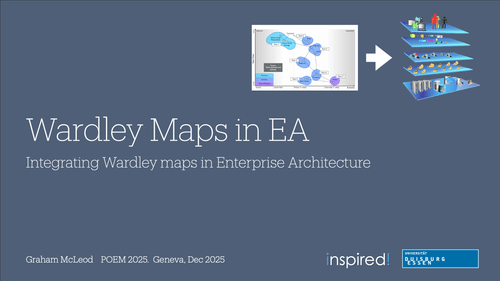
Wardley Maps in Enterprise Architecture

How can Wardley Maps be integrated with Enterprise Architecture frameworks to improve strategic planning?

These slides accompany the paper: Wardley Maps in Enterprise Architecture

Most Enterprise Architecture frameworks — including TOGAF, ArchiMate, and Zachman — address business and technology change effectively, but few formally account for the broader context in which an organisation operates: where it sits in its competitive landscape, how its components are evolving, and what strategic options that evolution creates. This paper argues that Wardley Mapping fills precisely that gap, and proposes a concrete approach for integrating it with EA practice. Drawing on the Inspired Holistic Architecture Language (HAL), Graham McLeod shows that nearly all the concepts required for Wardley Maps — stakeholders, capabilities, value chains, maturity levels — are already present in a well-constructed EA meta model, making integration more straightforward than it might appear. The paper introduces a stratified Wardley Map format that aligns visual layers with EA meta model types, and reports on early use of the integrated approach in client workshops and a Business Architecture Mastery Programme. For enterprise architects and business architects, this integration offers a practical way to add dynamic, evolution-aware thinking to existing EA models without starting from scratch.

Originally published as a conference paper in the PoEM 2025 Companion Proceedings (18th IFIP Working Conference on the Practice of Enterprise Modeling), Geneva, 2025.

Integrated Meta Model for Enterprise Modelling including Strategy, Business Architecture, Risk and Change

How can a single integrated meta model support strategy, business architecture, risk, and change across multiple EA frameworks — and why do existing approaches fall short?

These slides accompany the paper: Integrated Meta Model for Enterprise Modelling including Strategy, Business Architecture, Risk and Change

The major enterprise architecture frameworks each bring something valuable, but none are sufficient on their own. TOGAF covers IT domains reasonably well but lacks the contextual concepts — competitors, legislation, market forces, ecology — essential for genuine strategic planning. ArchiMate is more rigorous and consistent but weak on data modelling and context. BizBOK is focused but narrow. None of them, individually or together, provide a single coherent foundation for the full scope of strategy, business architecture, risk, change, and programme management that large transformation efforts demand.

This paper describes the development of HAL2023, the latest iteration of the Inspired Holistic Architecture Language — built by systematically analysing and synthesising TOGAF 10th Edition, ArchiMate 3.2, BizBOK 11, SABSA, MEMO, DODAF, and the accumulated Inspired consulting models. The result is a large but well-structured integrated meta model, expressed at three levels — rich pictures for executives, conceptual models for architects, and fully attributed models for tooling — and validated across projects in banking, telecommunications, assurance, retail, healthcare, and government. Notable enhancements in this revision include richer contextual coverage, rationalised relationship types, financial aspects, customer journeys, architecture scenarios, and improved integration with risk, governance, and initiative management.

Crucially, the paper is practical as well as theoretical: it explains how the model should be used incrementally rather than exhaustively, with teams populating only what is relevant to current goals — progressively expanding coverage as new questions arise, much like the way an ERP system delivers increasing value as more modules are adopted.

Originally published as a conference paper by Graham McLeod in the PoEM 2023 Companion Proceedings (16th IFIP Working Conference on the Practice of Enterprise Modeling), Vienna, 2023.