

Maturity Model

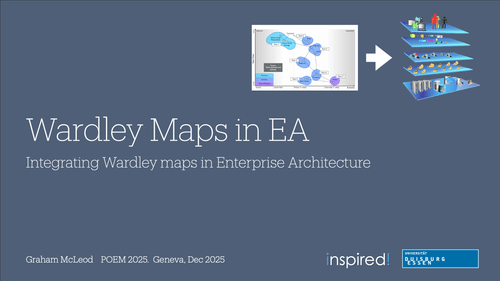
Wardley Maps in Enterprise Architecture

How can Wardley Maps be integrated with Enterprise Architecture frameworks to improve strategic planning?

These slides accompany the paper: Wardley Maps in Enterprise Architecture

Most Enterprise Architecture frameworks — including TOGAF, ArchiMate, and Zachman — address business and technology change effectively, but few formally account for the broader context in which an organisation operates: where it sits in its competitive landscape, how its components are evolving, and what strategic options that evolution creates. This paper argues that Wardley Mapping fills precisely that gap, and proposes a concrete approach for integrating it with EA practice. Drawing on the Inspired Holistic Architecture Language (HAL), Graham McLeod shows that nearly all the concepts required for Wardley Maps — stakeholders, capabilities, value chains, maturity levels — are already present in a well-constructed EA meta model, making integration more straightforward than it might appear. The paper introduces a stratified Wardley Map format that aligns visual layers with EA meta model types, and reports on early use of the integrated approach in client workshops and a Business Architecture Mastery Programme. For enterprise architects and business architects, this integration offers a practical way to add dynamic, evolution-aware thinking to existing EA models without starting from scratch.

Originally published as a conference paper in the PoEM 2025 Companion Proceedings (18th IFIP Working Conference on the Practice of Enterprise Modeling), Geneva, 2025.
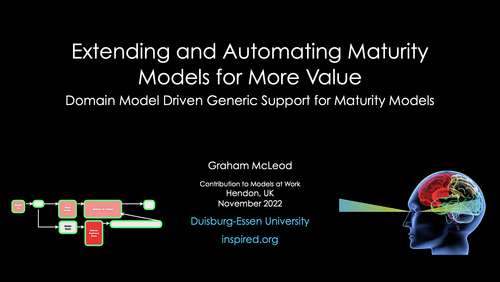
Extending and Automating Maturity Models for More Value

How can maturity models be extended beyond a simple rating to deliver recommendations, prioritised actions, and a path forward — and automated to remove the friction of doing so?

These slides accompany the paper: Extending and Automating Maturity Models for More Value

Maturity models are a staple diagnostic tool in enterprise architecture and information systems — but in practice, their value is often squandered. Organisations complete an assessment, receive a score, and are left to figure out what to do next. The friction of collecting data, calculating ratings, and managing results over time further discourages repeated use. This paper tackles both problems: how to extend the model itself to provide genuine guidance, and how to automate the process so that the effort of running an assessment becomes trivial.

The paper presents a generic domain model for maturity assessment, developed and validated at Inspired.org, which supports not just scoring across multiple dimensions but also recommendations tied to each gap between maturity levels, with relative effort ratings and dependency relationships between recommended actions. An algorithm prioritises recommendations by combining score gaps, effort, and dependency order — producing a ranked, actionable improvement plan rather than a list of observations. The domain model was implemented in the EVA platform in approximately two hours, with the full online assessment flow — including Kiviat chart scoring, recommendation presentation, action selection, and Gantt chart export — delivered in under a week. APIs were subsequently added to support integration with partner systems, adding around three days of effort.

The paper concludes with a reflection on Return on Modelling Effort (ROME): working at the domain concept level, rather than writing custom application code, enabled rapid delivery, easy adaptation, and high reuse — making this a compelling case for meta model-driven, low-code approaches to enterprise tooling.

Originally published as a journal article by Graham McLeod in the EMISA Journal (Enterprise Modelling and Information Systems Architectures), with a companion presentation at the Models at Work stream, PoEM 2022.