
How can Wardley Maps be integrated with Enterprise Architecture frameworks to improve strategic planning?
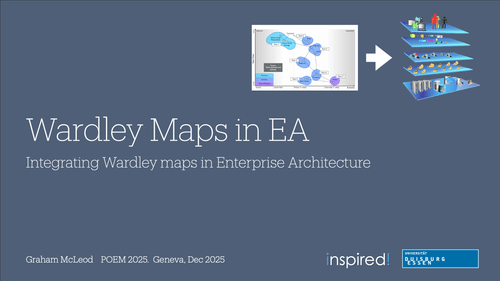
These slides accompany the paper: Wardley Maps in Enterprise Architecture
Most Enterprise Architecture frameworks — including TOGAF, ArchiMate, and Zachman — address business and technology change effectively, but few formally account for the broader context in which an organisation operates: where it sits in its competitive landscape, how its components are evolving, and what strategic options that evolution creates. This paper argues that Wardley Mapping fills precisely that gap, and proposes a concrete approach for integrating it with EA practice. Drawing on the Inspired Holistic Architecture Language (HAL), Graham McLeod shows that nearly all the concepts required for Wardley Maps — stakeholders, capabilities, value chains, maturity levels — are already present in a well-constructed EA meta model, making integration more straightforward than it might appear. The paper introduces a stratified Wardley Map format that aligns visual layers with EA meta model types, and reports on early use of the integrated approach in client workshops and a Business Architecture Mastery Programme. For enterprise architects and business architects, this integration offers a practical way to add dynamic, evolution-aware thinking to existing EA models without starting from scratch.
Originally published as a conference paper in the PoEM 2025 Companion Proceedings (18th IFIP Working Conference on the Practice of Enterprise Modeling), Geneva, 2025.