
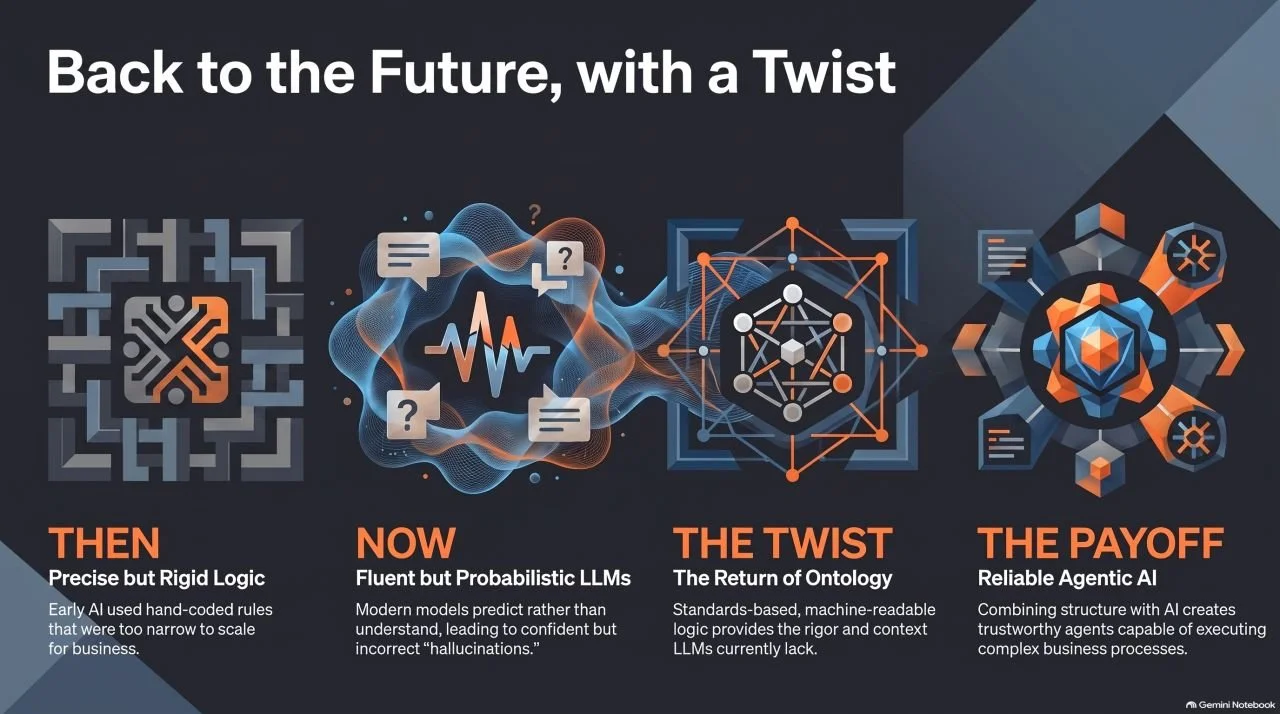
In the early days of AI, rules were laboriously translated to code to provide logic guiding expert systems. These had some success in very narrow use cases. They failed in the broader context of general business and industry. Often this was due to their lack of context (general knowledge), lack of standards for rule definition, inability to understand natural language and sheer effort of encoding the expert knowledge in machine usable form.
The field took a leap forward with machine learning - using computer power to iterate massively on algorithms or large sets of data and, with human guidance, allow the system to improve its performance. Transformer architecture and massive data sets (aka the Internet, social media, wikipedia etc. ) took this to another level in large language models. These are spookily capable, generally well informed (in terms of general knowledge), handle natural language competently and perform well on generic problems. They do still, however, exhibit hallucinations where they can give confident, well articulated answers which are totally wrong. This shows that they do not understand what they are processing, but work on prediction and probability. They can be made deterministic, but only if we can provide local data, context and rules in a very structured, standard, machine accessible format, preferably at scale and at runtime.
In parallel, the fields of logic, reasoning and ontology have grown up. Efforts like the Semantic Web and the Human Genome Project required defining, capturing, linking and integrating huge quantities of information. Standards have emerged for describing data in terms of conceptual graphs (RDF, RDFS, OWL) as well as constraints, derivations, inferences (SHACL, CLIF). These have been used to define standard top level ontologies (BFO, UFO) which provide a foundation on which to build more specific domain ontologies. OWL, SHACL and CLIF provide ways to link the logic to the data and express it in standard, technology neutral ways.
We are now witnessing the emergence of platforms (Palantir, SAP Knowledge Graph, Microsoft Fabric IQ, Enterprise Web) which leverage enterprise ontology at run time to provide an integrated application landscape for business execution. This is filling the gap to enable reliable agentic processes by providing AI with structured, rigorous guidance on data and business logic. Some of these platforms encode the ontology in proprietary or technology specific format with resultant danger of vendor lock in. I predict that there will be a second wave where this knowledge is captured by organisations themselves as their digital business operating model and a core IP asset. They can then deploy this on a platform of choice able to ingest it using the standards mentioned above.
Watch this space for news of our own ontology modelling and execution platform (Sapiento) and an emerging enterprise ontology based upon standards (AEON).