
Why enterprise AI has made a thirty-year-old question urgent — and what the move from Information Engineering, UML and relational modelling to graph, semantic and ontology-driven execution actually demands of practitioners.
The problem is not the model. It's the ground truth.
Shared meaning is not a new problem. Warehouse teams have been fighting "whose definition of revenue?" for thirty years. What changed is who is now reading the data.
A traditional report was read by an analyst who knew that "active customers" in the marketing dashboard was not the "active" the risk team used. She carried the caveat in her head, applied it, and moved on. The ambiguity was real but bounded — it lived in a few expert skulls and travelled no further than a meeting.
Put an agent in that seat. Ask it "how many active customers do we have in the North region, and what is their total exposure?" It will join the marketing table's active flag to the risk system's exposure column, sum the result, and return a confident number in fluent prose. It does not know the two systems mean different things by customer. It has no caveat. And its output looks exactly as authoritative as a correct answer would.
Three properties of AI-mediated work turn latent ambiguity into active cost:
Amplification. A human analyst makes one join an hour. An agent makes thousands, unsupervised. Every wrong assumption about what a field means is now executed at machine scale
Composition. Agents chain steps. A subtly wrong definition at step one propagates, and by step five the provenance of the error is gone. The answer is wrong and unexplainable at once
Opacity of confidence. The failure mode is not a crash or a NULL. It is a plausible, wrong, actionable answer - the expensive kind
The instinct, when the agent gets it wrong, is to reach for a bigger model or better prompts. But the error is not in the model's reasoning. It is in the ground truth the model reasoned over. If customer denotes four different things in four systems, no amount of model capability recovers the one you meant — because that thing was never written down anywhere a machine could read it.
Semantics is the missing input, not a missing capability.
"Semantic" means five different things
Here is where most programmes go wrong before they start. "Semantic layer" is the most overloaded phrase in enterprise data. Serious people use it to mean at least five distinct things that live in different places, are owned by different people, cost different amounts and solve different problems.
They are not rival definitions. They are a stack:
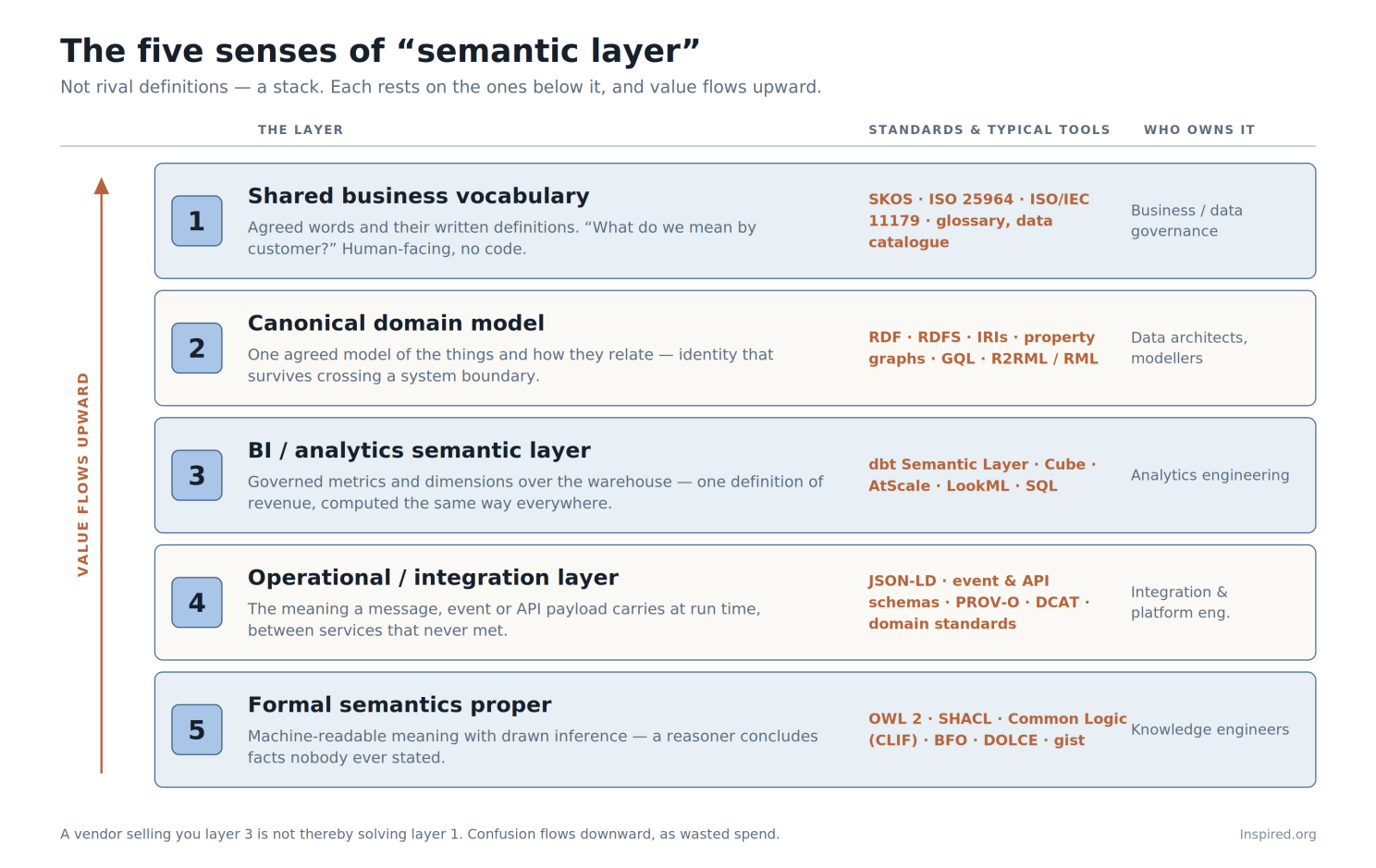
Read one word — customer — down that stack and the point becomes clear. Each reading is legitimate. Each is owned by a different team. Each fails in a different way.
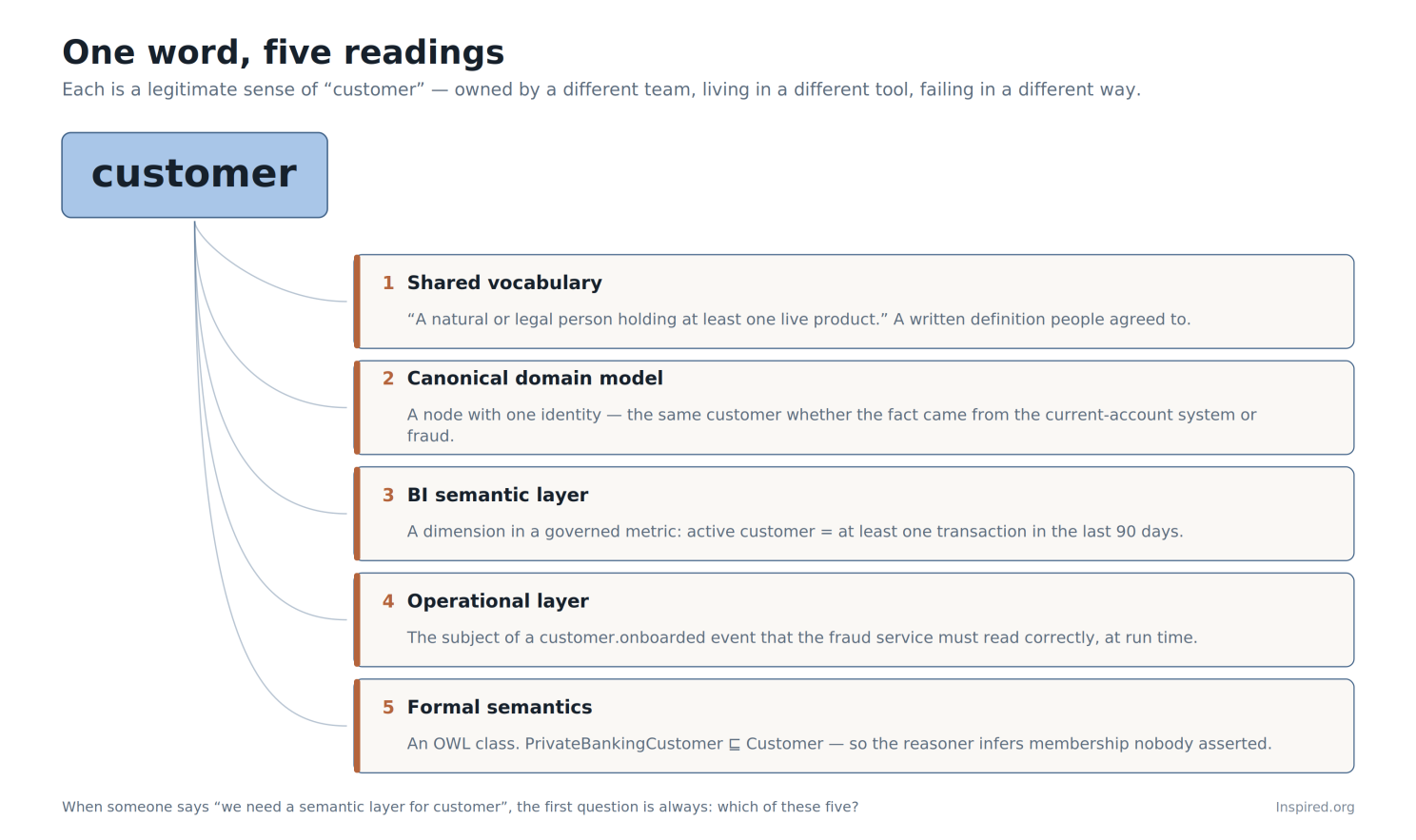
Why this matters commercially: a retail bank funds a "Single View of Customer" programme. The deck talks about AI. The budget goes on a layer-3 analytics semantic layer, because that is what the vendor demonstrated. Eighteen months later the executive dashboard still shows three different customer counts — because the actual problem was layer 2. The same person exists as four unreconciled records in four systems, and no metrics layer reconciles identities it was never given. The programme built a precise calculator on top of an unresolved question.
Buying layer 3 to fix a layer-1 or layer-2 problem is the single most expensive mistake in this field.
Four demands, and the standards that answer them
1. Shared meaning — a common controlled vocabulary
Before anything else: do people agree what the words denote? "A customer is a natural or legal person who holds at least one live product with the bank." Plain language, agreed by humans, no code.
Most "data quality" disputes are vocabulary disputes wearing a technical costume. The formalisation is cheap and unglamorous: SKOS — the Simple Knowledge Organization System (W3C Recommendation, 2009) gives you concepts, preferred and alternative labels, broader/narrower hierarchies and mappings between schemes. ISO 25964 covers thesaurus construction and interoperability; ISO/IEC 11179 covers metadata registries and the discipline of naming and defining a data element properly.
This is the twenty per cent of the stack that needs no logic at all and returns most of the value. Skip it and everything above inherits the ambiguity.
2. Agreed derivation — the semantic layer for BI
Everyone agrees what a customer is, and two dashboards still disagree on the count, because the calculation lives in two places. The answer is a governed metric definition — active customer = at least one transaction in the last 90 days — written once, over the warehouse, and resolved identically by the dashboard, the notebook and the agent.
This is the sense most vendors mean today: the dbt Semantic Layer, Cube, AtScale, LookML. It is genuinely valuable, and it is also where the confusion concentrates, because it is the layer with the biggest marketing budget. A metrics layer computes flawlessly over whichever records you feed it. If those are four unreconciled customers, the metric is precise and wrong.
The real prize here is not the dashboard. It is that an agent can call a governed metric instead of misjoining raw tables.
3. Integration and interoperability — semantic expression
Point-to-point mapping does not survive past a handful of systems: n systems need n(n−1)/2 mappings, each with its own quiet assumptions. Meaning that travels needs to be expressed in a form that is not owned by any one system.
Semantic data is best expressed in graphs. A graph is a connected set of statements, conceptually nodes and edges. e.g. John -worksFor-> Enron -sells-> Oil
Graphs can be stored in simple fact statements (see RDF) or Labelled Property Graphs (see LPG)
RDF — the Resource Description Framework (W3C; RDF 1.1 in 2014, with RDF 1.2 reaching Candidate Recommendation in April 2026) reduces everything to the triple: subject, predicate, object. e.g. John worksFor Enron; Enron sells Oil. RDFS — RDF Schema adds classes, properties and subsumption (class subtyping)
IRIs — Internationalized Resource Identifiers replace local primary keys with globally resolvable names, so "the same customer" is a claim two systems can actually make
SPARQL — the SPARQL Protocol and RDF Query Language (1.1, 2013; 1.2 in draft) provides queries and updates across a graph of triples
RDF vs LPG — RDF data stores (otherwise known as Triple Stores) can accommodate data without schema (or with) and can expand easily to accommodate new data without structure change. They are best for integrating data from heterogeneous sources. Labelled Property Graphs are more efficient and best for transactional and operational data
R2RML — the Relational DB to RDF Mapping Language (W3C, 2012) and RML — the RDF Mapping Language lift the relational and file-based estate you already have into RDF form, declaratively, without rewriting the sources
JSON-LD — JavaScript Object Notation for Linked Data (1.1, W3C, 2020) carries the same meaning inside ordinary API payloads, which is how layer 4 gets done in practice
On the property-graph side, GQL — the Graph Query Language (ISO/IEC 39075:2024) is now an ISO standard in its own right, and SQL/PGQ (part of ISO/IEC 9075:2023) brings graph pattern matching into SQL. The RDF-versus-LPG argument is largely over: mature programmes run both and bridge between them
Reuse beats invention: There are many sources of well defined models addressing generic requirements as well as specific disciplines. Consult schema.org, FIBO — the Financial Industry Business Ontology, SNOMED CT — Systematized Nomenclature of Medicine, Clinical Terms, QUDT — Quantities, Units, Dimensions and Data Types, PROV-O — the PROV Ontology for provenance, DCAT — the Data Catalog Vocabulary for datasets
Using these technologies allows merging and reaching consensus on definition and holding that stable and shared in a standard format.
4. Reliability and agentic automation — formal ontology backed by logic
Here the stakes change. If an agent acts on your model, "roughly right" stops being a documentation problem and becomes an operational risk. That demands semantics formal enough for a machine to check.
OWL 2 — the Web Ontology Language (W3C Recommendation, 2012) sits on description logics, a decidable fragment of first-order logic. Its profiles — EL, QL, RL and the full DL — are deliberate trade-offs between what you can say and what a reasoner can compute in reasonable time. Choosing the profile is an architectural decision, not a detail
SHACL — the Shapes Constraint Language (W3C Recommendation, 2017; 1.2 drafts in progress) does the job OWL was never designed for: validating that actual data conforms to a stated shape. OWL says what things are; SHACL says what a valid record looks like. Conflating them is the most common beginner error in the field
Common Logic (ISO/IEC 24707:2018), and its CLIF — Common Logic Interchange Format syntax, expresses the constraints description logic deliberately cannot: n-ary relations, multi-property rules, conditions over time. Paired with a theorem prover and a model finder, it also lets you verify an ontology — state the intended models, prove the entailments you expect, and check that your axioms are independent and consistent. This is the discipline that separates an engineered ontology from a plausible-looking one
Top-level ontologies give your concepts somewhere to stand: BFO — the Basic Formal Ontology (ISO/IEC 21838-2:2021), DOLCE — the Descriptive Ontology for Linguistic and Cognitive Engineering, and gist (Semantic Arts small business high level ontology). OntoClean (Guarino & Welty) supplies the analytical tests — identity, rigidity, unity, dependence — that catch the taxonomy errors everyone else ships
Only at this rung does an agent get something it can be held to: classifications it can derive, constraints it can be blocked by, and an audit trail explaining why it concluded what it concluded.
The transition practitioners actually have to make
To be fair to the tools we already use, they carried us a very long way and none of this asks you to throw them out.
Codd's relational model (1970) gave data a rigorous mathematical foundation and the normalisation theory that removes update anomalies — arguably the most successful idea in applied computing. Chen's entity-relationship modelling (1976) gave us the picture: entities, attributes, cardinalities, drawn so a business person can read it and a database can be generated from it. UML class diagrams and the wider Information Engineering tradition added object structure and the discipline of conceptual → logical → physical design. The patterns literature — Hay, Simsion & Witt — is full of hard-won wisdom that remains correct: the Party pattern, role versus thing, resolving many-to-many relationships properly.
All of it comes with you. Graph modelling is not a rejection of data modelling. It is data modelling with the assumptions resolved.
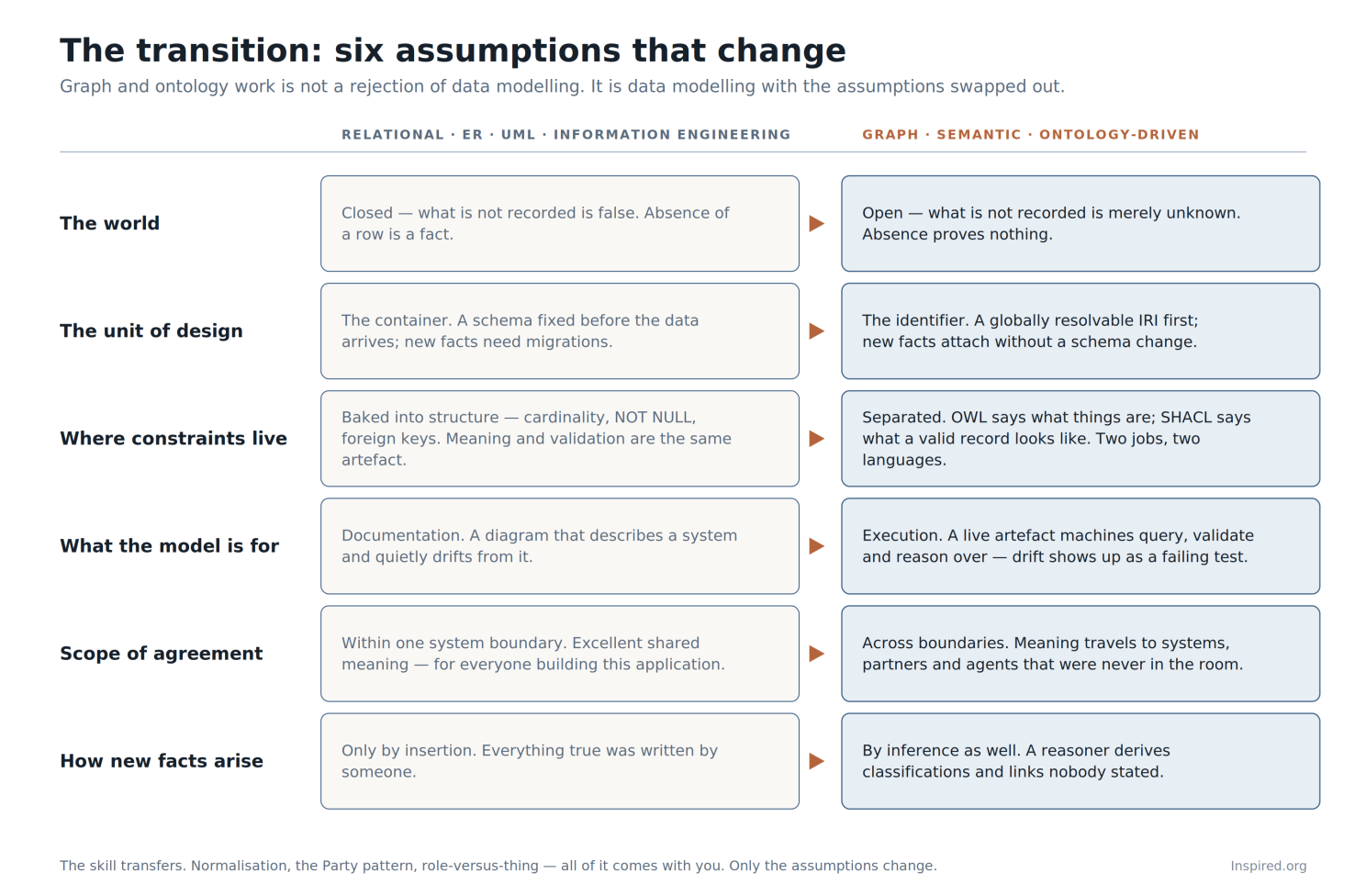
The hard part is not the standards. It is the unlearning — and in my experience excellent data modellers find this transition harder than beginners do, precisely because the old instincts are so good. Thirty years of closed-world reflexes ("if there's no row, it didn't happen") do not switch off because you read the OWL primer. Training has to be designed around that, not around the specification.
Where to start
Most enterprises need a great deal of layers 1 to 3 and a careful, small amount of layer 5. Formal ontology is the most powerful and the most over-applied technique on the map. Reaching for OWL when a governed glossary and a resolved identity would have done is how semantic programmes acquire their reputation for cost and delay.
There is a newer failure mode too. Large language models will happily draft you an ontology in minutes. Without competency questions, OntoClean analysis, SHACL validation and reasoner checks, what you get is a vibe ontology: fluent, plausible, and unverifiable — the same failure as the confident wrong answer, one level further up the stack. Assisted, then verified. In that order.
What we're doing about it
These threads — shared vocabulary, the canonical model, the semantic layer, integration, formal ontology, and the bridge into agentic AI — are what we have spent this year building a training path around.
We're introducing it as two courses: a transition course for commercial analysts, BI practitioners and domain experts who need to become the bridge to semantic work; and an advanced engineering course for modellers, ontologists and AI implementors who have to build the solution and put it into production.
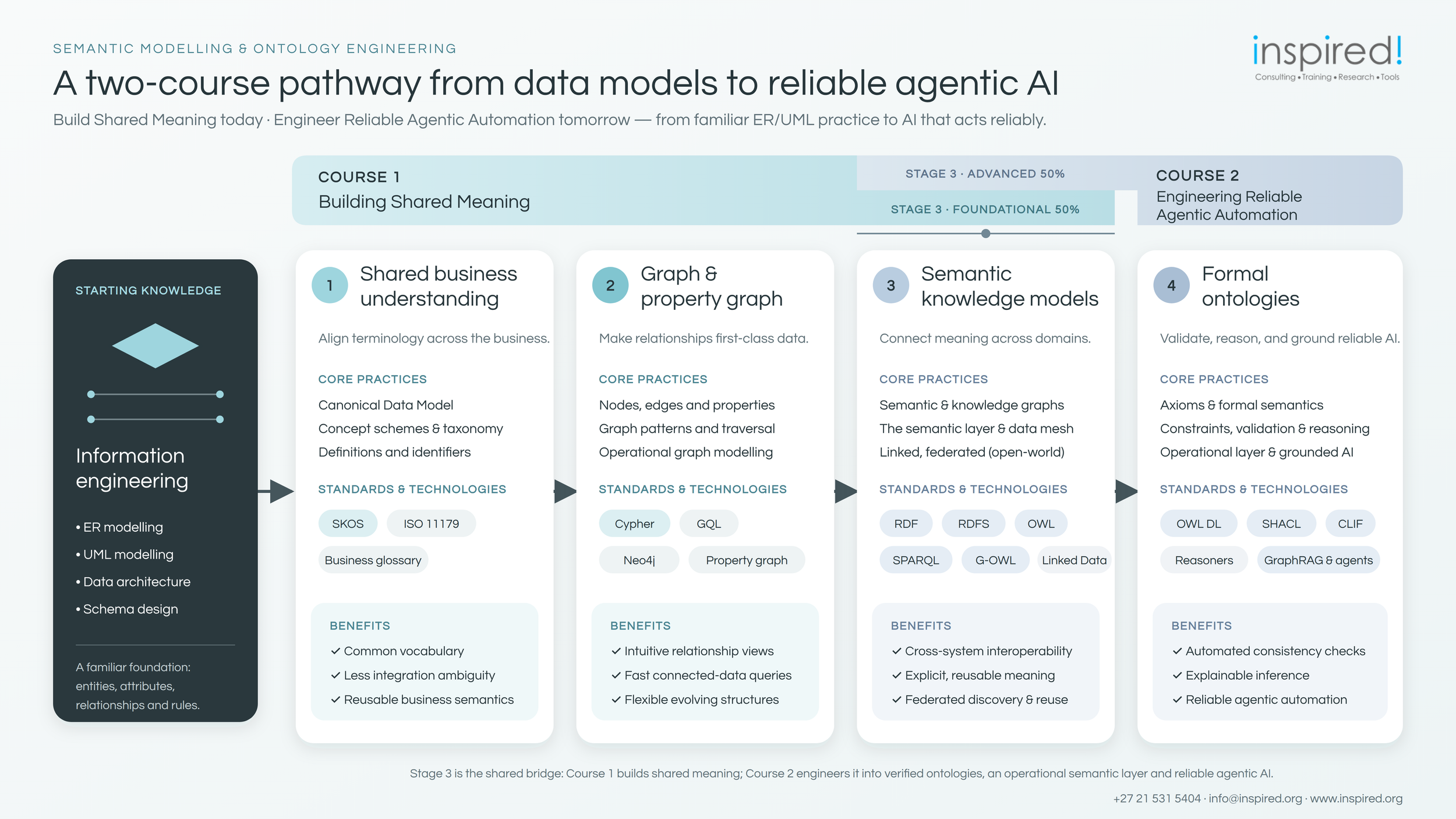
Ready to make this shift on your own data estate?
Course 1: Building Shared Meaning starts 19–23 October.
References and standards
Standards
W3C, RDF 1.1 Concepts and Abstract Syntax, Recommendation, 2014 — w3.org/TR/rdf11-concepts; RDF 1.2 Concepts and Abstract Data Model, Candidate Recommendation, 2026 — w3.org/TR/rdf12-concepts
W3C, SKOS Simple Knowledge Organization System Reference, Recommendation, 2009 — w3.org/TR/skos-reference
W3C, OWL 2 Web Ontology Language Primer, 2nd edition, 2012 — w3.org/TR/owl2-primer
W3C, Shapes Constraint Language (SHACL), Recommendation, 2017 — w3.org/TR/shacl; SHACL 1.2 Core, Working Draft — w3.org/TR/shacl12-core
W3C, SPARQL 1.1 Query Language, Recommendation, 2013 — w3.org/TR/sparql11-query
W3C, R2RML: RDB to RDF Mapping Language, Recommendation, 2012 — w3.org/TR/r2rml
W3C, JSON-LD 1.1, Recommendation, 2020 — w3.org/TR/json-ld11
ISO/IEC 39075:2024, Information technology — Database languages — GQL
ISO/IEC 24707:2018, Information technology — Common Logic (CL)
ISO/IEC 21838-2:2021, Top-level ontologies — Basic Formal Ontology (BFO)
ISO 25964, Thesauri and interoperability with other vocabularies; ISO/IEC 11179, Metadata registries
Literature
Codd, E.F. (1970), "A Relational Model of Data for Large Shared Data Banks", Communications of the ACM 13(6).
Chen, P. (1976), "The Entity-Relationship Model — Toward a Unified View of Data", ACM TODS 1(1).
Berners-Lee, T., Hendler, J. & Lassila, O. (2001), "The Semantic Web", Scientific American.
Guarino, N. & Welty, C. (2009), "An Overview of OntoClean", in Handbook on Ontologies, Springer.
Allemang, D., Hendler, J. & Gandon, F. (2020), Semantic Web for the Working Ontologist, 3rd edition, ACM Books.
Hogan, A. et al. (2021), "Knowledge Graphs", ACM Computing Surveys 54(4).
Noy, N. et al. (2019), "Industry-scale Knowledge Graphs: Lessons and Challenges", Communications of the ACM 62(8).
Suárez-Figueroa, M.C. et al. (2012), Ontology Engineering in a Networked World (the NeOn methodology), Springer.
Grüninger, M. & Fox, M. (1995), "Methodology for the Design and Evaluation of Ontologies", IJCAI Workshop on Basic Ontological Issues in Knowledge Sharing.
Lewis, P. et al. (2020), "Retrieval-Augmented Generation for Knowledge-Intensive NLP Tasks", NeurIPS — arXiv:2005.11401
Edge, D. et al. (2024), "From Local to Global: A Graph RAG Approach to Query-Focused Summarization" — arXiv:2404.16130
Graham McLeod · Inspired.org