

SHACL

Building a Business Ontology

Building a Business Ontology Webinar Cover Image

These slides accompany the webinar hosted by Ecosystem.ai on 16 September 2026, presented by Graham McLeod.

Building a Business Ontology is a practical look at how to go from agreed business language to a formal ontology that can support reliable automation and AI agents. The session includes a live demo of Sapiento.

We cover:

  • The five different meanings of “semantic layer”, and why it matters which one you need

  • Shared business vocabulary with SKOS

  • The canonical domain model

  • The BI and integration semantic layers

  • Formal ontology with OWL, SHACL and CLIF, and why it matters for reliable agentic AI

  • How to produce an ontology: inputs, process and outputs, including reuse of existing source ontologies (BFO, gist, FIBO, schema.org and others)

  • Usage and benefits: generating schemas and code, reliable BI, compliance, and agentic workflows at scale

  • The two-course pathway from data models to reliable agentic AI

  • Sapiento: a graph-based modelling and execution environment, with demos of a G-OWL model, aligning two ontologies and exporting to Turtle

Perfect for enterprise architects, data modellers, BI practitioners and AI engineers who want to build the structured knowledge that makes AI more reliable.

🌐 Ecosystem.ai: https://ecosystem.ai
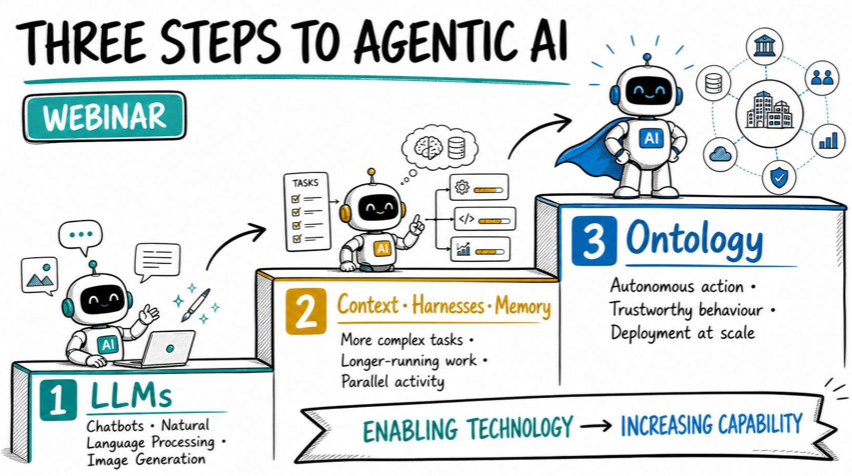
Educating AI: Ontologies That Help AI Reason Better and Hallucinate Less

These slides accompany the webinar: Educating AI: Ontologies That Help AI Reason Better and Hallucinate Less

Large Language Models are powerful — but they hallucinate, and they can't be trusted to act autonomously without structured guidance. In this session, Graham McLeod explains how ontologies provide the knowledge layer that helps AI reason reliably, make deterministic decisions, and reduce hallucinations in enterprise environments.

Recorded at the Educating AI webinar hosted by Ecosystem.ai on 5 August 2026.

We cover:

  • What ontologies are and why enterprises need them

  • Core building blocks: types, relationships, roles, properties, and constraints

  • Key standards: OWL, RDF, SHACL, Turtle, and SPARQL

  • How knowledge graphs enable trustworthy AI agents

  • Avoiding vendor lock-in from platforms like Palantir, Google, and Microsoft Fabric

  • The Accessible Enterprise Ontology (AON) initiative

  • Sapiento: a graph-based modeling and execution tool

  • The open-source "Flow" platform for vendor-agnostic SQL queries

Perfect for enterprise architects, AI engineers, and anyone exploring how structured knowledge can make LLMs more reliable.

🌐 Ecosystem.ai — Real-time AI personalization and prediction platform
https://ecosystem.ai